
Judicial Individuality on the UK Supreme Court

Judicial Individuality on the UK Supreme Court

Lewis Graham

85,69 €
IVA incluido
Disponible
Editorial:
Bloomsbury Publishing plc
Año de edición:
2026
ISBN:
9781509971145
85,69 €
IVA incluido
Disponible

Selecciona una librería:

  • Librería Samer Atenea

  • Kálamo Books
  • Librería Elías (Asturias)
  • Librería Kolima (Madrid)
  • Librería Proteo (Málaga)

This book presents an empirical analysis of the UK Supreme Court’s output over its first ten years, with a specific focus on each individual judge’s contribution to each case.It shows that judges, like all of us, are human; it would be difficult to imagine that any of us, even in our most professional capacity, could act completely independently of our predilections, motivations and biases. The same is true for the judges sitting on the UK’s highest court.Drawing on insights from a bespoke dataset of judgments, this work discerns trends and tendencies across each judge’s voting patterns and the reasoning they adopt when disposing of cases. It not only highlights areas of divergence, but also shows how each of the judges tended to vote in different contexts, including which were more likely to overturn appeals from lower courts, side with certain parties such as the state or underdogs, and find liability in various areas (tort, contract, criminal, EU, immigration and tax law, with a special focus on human rights cases). Another section illustrates the differences between the judges when it comes to judicial reasoning, such as their approach to precedent and preferred methods of statutory interpretation. This work shows that different judges exercise their power in different ways. Some are more comfortable with pushing boundaries whilst others are more restrained. Some grant the state a lot of leeway whilst others apply heavy scrutiny. Some are, as Lord Denning suggested, ’bold spirits’ whilst others are ’timorous souls’. It shows, at least when it comes to the Supreme Court, that it matters who our judges are. 6
Artículos relacionados

  • Building the Judiciary
    Justin Crowe
    How did the federal judiciary transcend early limitations to become a powerful institution of American governance? How did the Supreme Court move from political irrelevance to political centrality? Building the Judiciary uncovers the causes and consequences of judicial institution-building in the United States from the commencement of the new government in 1789 through the clos...
    Disponible

    75,06 €

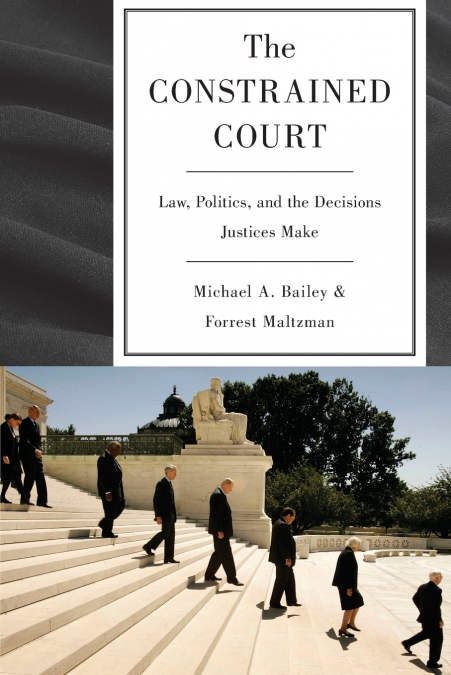
  • The Constrained Court
    Forrest Maltzman / Michael A. Bailey
    How do Supreme Court justices decide their cases? Do they follow their policy preferences? Or are they constrained by the law and by other political actors? The Constrained Court combines new theoretical insights and extensive data analysis to show that law and politics together shape the behavior of justices on the Supreme Court. Michael Bailey and Forrest Maltzman show how t...
    Disponible

    53,10 €

  • Emma Goldman’s No-Conscription League and the First Amendment
    Erika Pribanic-Smith / Jared Schroeder
    In this short book, Schroeder and Pribanic-Smith analyze the communications that led to Goldman’s arrest--writings in Mother Earth, a mass-mailed manifesto, and speeches related to compulsory military service during World War I. ...
    Disponible

    51,39 €

  • Emma Goldman’s No-Conscription League and the First Amendment
    Erika J. Pribanic-Smith / Erika Pribanic-Smith / Jared Schroeder
    In this short book, Schroeder and Pribanic-Smith analyze the communications that led to Goldman’s arrest--writings in Mother Earth, a mass-mailed manifesto, and speeches related to compulsory military service during World War I. ...
  • Judicial Independence in China
    Randall Peerenboom
    ...
    Disponible

    61,08 €

  • Decision Making by the Modern Supreme Court
    Brett W. Curry / Brett WCurry / Bryan W. Marshall / Bryan WMarshall / Richard L. Jr. Pacelle / Richard LJrPacelle
    ...
    Disponible

    52,77 €

Otros libros del autor

  • Judicial Individuality on the UK Supreme Court
    Lewis Graham
    This book presents an empirical analysis of the UK Supreme Court’s output over its first ten years, with a specific focus on each individual judge’s contribution to each case.It shows that judges, like all of us, are human; it would be difficult to imagine that any of us, even in our most professional capacity, could act completely independently of our predilections, motivation...