Pa.) Franklin Institute (Philadelphia
 Librería Samer Atenea
 Kálamo Books
 Librería Elías (Asturias)
 Librería Kolima (Madrid)
 Librería Proteo (Málaga)
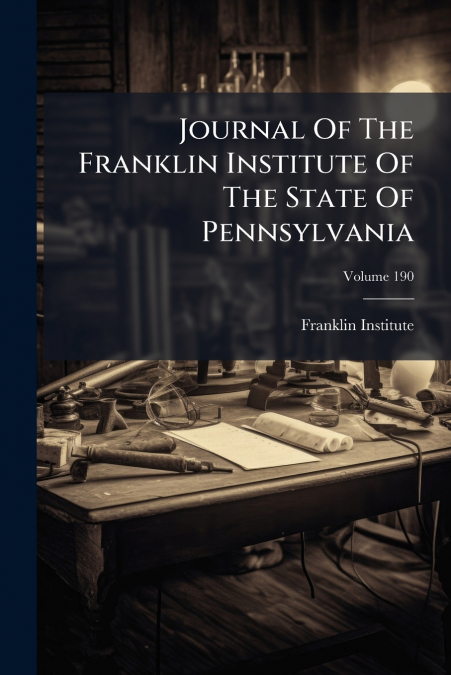
Explore the rich history of scientific and technological innovation with 'Journal Of The Franklin Institute Of The State Of Pennsylvania, Volume 190.' This meticulously preserved volume offers a fascinating glimpse into the groundbreaking research, discoveries, and discussions that shaped the scientific landscape of its time. Published by the esteemed Franklin Institute, a cornerstone of American scientific progress, this journal captures the spirit of inquiry and the relentless pursuit of knowledge that defined an era. Delve into detailed articles, reports, and analyses covering a wide array of scientific and technical subjects. This historical record is invaluable for researchers, historians, and anyone with a passion for understanding the evolution of science and technology. Experience the legacy of the Franklin Institute and its enduring contribution to the advancement of human understanding. This work has been selected by scholars as being culturally important, and is part of the knowledge base of civilization as we know it. This work was reproduced from the original artifact, and remains as true to the original work as possible. Therefore, you will see the original copyright references, library stamps (as most of these works have been housed in our most important libraries around the world), and other notations in the work.This work is in the public domain in the United States of America, and possibly other nations. Within the United States, you may freely copy and distribute this work, as no entity (individual or corporate) has a copyright on the body of the work.As a reproduction of a historical artifact, this work may contain missing or blurred pages, poor pictures, errant marks, etc. Scholars believe, and we concur, that this work is important enough to be preserved, reproduced, and made generally available to the public. We appreciate your support of the preservation process, and thank you for being an important part of keeping this knowledge alive and relevant.