 Librería Samer Atenea
 Kálamo Books
 Librería Elías (Asturias)
 Librería Kolima (Madrid)
 Librería Proteo (Málaga)
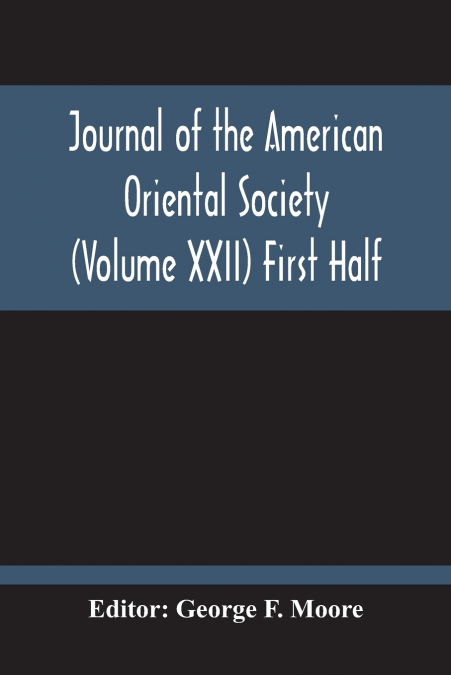
A vivid record of nineteenth century scholarship and the beginnings of American engagement with the East. Essential reading for curious minds.Journal Of The American Oriental Society (Volume XXII) First Half, by F. Moore, George, is a representative oriental studies journal drawn from Victorian era publications that shaped modern philology. This academic periodical collection gathers articles, notes and reviews devoted to ancient near east research, linguistic and philological studies and comparative religion essays, presenting arguments and source material still cited by historians and linguists. Useful as both a readable introduction and a rigorous source, it speaks to students, amateurs with a taste for classical inquiry and specialists: scholars of orientalism will find original lineaments of thought, while libraries will recognise it as a durable university library reference and an insight into the methods behind historical linguistics resources.Republished by Alpha Editions in a careful modern edition, this volume preserves the spirit of the original while making it effortless to enjoy today - a heritage title prepared for readers and collectors alike. Its historical significance is plain: across pieces collected here, the American Oriental Society codified debates that advanced comparative approaches to language, myth and antiquity, making the volume a meaningful node in the development of classical studies anthology and nineteenth century scholarship. The essays and reviews document early methodologies that later informed modern philology, and they remain a rich vein for anyone consulting historical linguistics resources or tracing the emergence of comparative religion study in America. Casual readers will be rewarded by clear, argumentative prose and the thrill of discovery; classic literature collectors and institutional curators will value a work that bridges Victorian era curiosity and enduring academic purpose. As an object of study the book doubles as a snapshot of scholarly networks: editors, reviewers and correspondents across these pages reveal the intellectual ties between American universities and the broader European debates of the time. Whether sought for reading or reference, the volume sits comfortably between a university library reference and a personal classical studies anthology.