 Librería Samer Atenea
 Kálamo Books
 Librería Elías (Asturias)
 Librería Kolima (Madrid)
 Librería Proteo (Málaga)
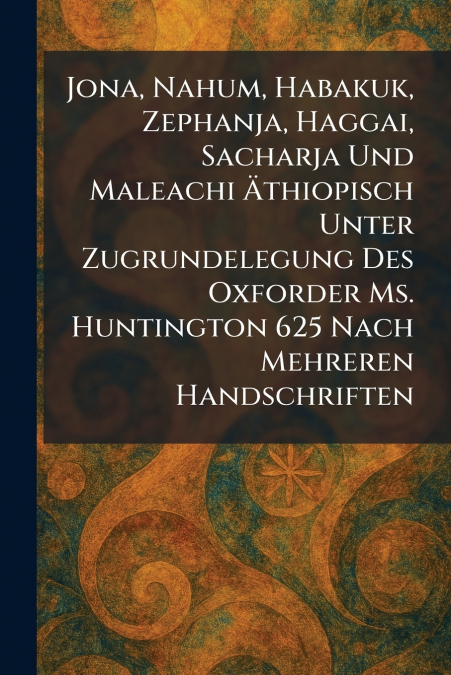
Diese wissenschaftliche Ausgabe präsentiert die äthiopischen Fassungen der biblischen Bücher 'Jona', 'Nahum', 'Habakuk', 'Zephanja', 'Haggai', 'Sacharja' und 'Maleachi'. Grundlage dieser Edition ist das renommierte Oxforder Manuskript Huntington 625, wobei weitere bedeutende Handschriften für eine umfassende textkritische Aufarbeitung herangezogen wurden. Das Werk bietet eine präzise philologische Darstellung dieser prophetischen Schriften in der sakralen Ge’ez-Sprache.Als wichtiges Dokument der orientalischen Christenheit ermöglicht dieser Band tiefe Einblicke in die Ãberlieferungsgeschichte des Alten Testaments in Ãthiopien. Die sorgfältige Gegenüberstellung der Quellen macht das Buch zu einer wertvollen Ressource für Fachleute der Semitistik, Theologie und Bibelwissenschaft. Es unterstreicht die historische und literarische Bedeutung der äthiopischen Bibeltradition und bewahrt den Zugang zu diesen antiken Texten für die moderne Forschung.This work has been selected by scholars as being culturally important, and is part of the knowledge base of civilization as we know it. This work was reproduced from the original artifact, and remains as true to the original work as possible. Therefore, you may see the original copyright references, library stamps (as most of these works have been housed in our most important libraries around the world), and other notations in the work.This work is in the public domain in the United States of America, and possibly other nations. Within the United States, you may freely copy and distribute this work, as no entity (individual or corporate) has a copyright on the body of the work.As a reproduction of a historical artifact, this work may contain missing or blurred pages, poor pictures, errant marks, etc. Scholars believe, and we concur, that this work is important enough to be preserved, reproduced, and made generally available to the public. We appreciate your support of the preservation process, and thank you for being an important part of keeping this knowledge alive and relevant.