

 Librería Samer Atenea
 Kálamo Books
 Librería Elías (Asturias)
 Librería Kolima (Madrid)
 Librería Proteo (Málaga)
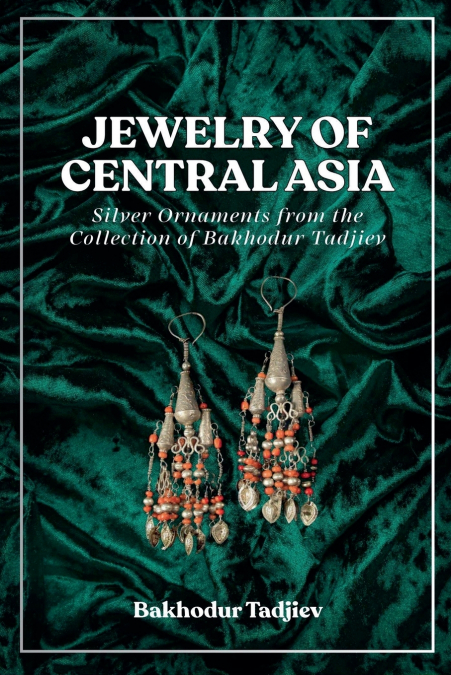
Jewelry of Central Asia: Silver Ornaments from the Collection of Bakhodur Tadjiev explores the rich traditions of Central Asian jewelry through the silver ornaments preserved in the collection of Bakhodur Tadjiev, a master jeweler and connoisseur of traditional craftsmanship.Encompassing the jewelry traditions of Uzbekistan, Tajikistan, Turkmenistan, Kazakhstan, Kyrgyzstan, and Karakalpakstan, the book examines silver ornaments as works of art, products of highly developed craftsmanship, elements of dress, expressions of identity, objects of protection, and carriers of cultural memory.The study traces the development of jewelry traditions across historic centers including Bukhara, Samarkand, Khiva, Khorezm, Kokand, and Tashkent, while also considering regional and community traditions beyond the major urban workshops. It explores the movement of forms, techniques, motifs, and materials across Central Asia, demonstrating how trade, migration, cultural exchange, and changing fashions contributed to the remarkable diversity of the region’s jewelry.Particular attention is devoted to the technical language of the jeweler. Chasing, repoussé, filigree, granulation, stamping, engraving, gilding, soldering, stone setting, and other processes are considered not simply as decorative techniques, but as evidence of workshop practice and specialized knowledge. The material properties of silver, its surface, traces of use, repairs, alterations, and methods of construction are likewise examined as clues to an object’s history.The book approaches jewelry through its relationship with the human body. Head and hair ornaments, earrings, neck and pectoral pieces, amulets, bracelets, rings, dress ornaments, and braid decorations are considered in relation to clothing, ceremony, age, gender, social position, protection, and memory. This perspective reveals jewelry as something intended not merely to be seen, but to be worn, handled, inherited, exchanged, and remembered.At the heart of the volume is the Bakhodur Tadjiev Collection. As a practicing master jeweler, Tadjiev approaches these objects not only as a collector, but also with an understanding of the materials, techniques, construction, and craftsmanship that define them. His collection brings together objects whose significance extends beyond their visual appearance, offering an opportunity to study the knowledge embodied in Central Asian silverwork.The book combines this practical perspective with historical and ethnographic scholarship. Attribution and dating are approached cautiously, drawing on observable construction, technique, materials, documented comparative examples, provenance, condition, and regional context. Where the available evidence does not permit a definitive conclusion, uncertainty is preserved rather than replaced by speculation.Jewelry of Central Asia is therefore both a study of the region’s silver-working heritage and a presentation of a collection shaped by the informed eye of a master jeweler. It invites readers to look closely at the objects-to appreciate their beauty and craftsmanship while also discovering the histories, traditions, skills, beliefs, and memories preserved within them.





