
Inicio > Sociedad y ciencias sociales > Política y gobierno > Relaciones internacionales > Jean-Marc Ferry et la réception contemporaine de Kant
Jean-Marc Ferry et la réception contemporaine de Kant

Jean-Marc Ferry et la réception contemporaine de Kant

Christian Mongay Nyabolondo

33,85 €
IVA incluido
Disponible
Editorial:
Editions L’Harmattan
Año de edición:
2025
Materia
Relaciones internacionales
ISBN:
9782336507040
33,85 €
IVA incluido
Disponible

Selecciona una librería:

  • Librería Samer Atenea
  • Librería Aciertas (Toledo)
  • Kálamo Books
  • Librería Perelló (Valencia)
  • Librería Elías (Asturias)
  • Donde los libros
  • Librería Kolima (Madrid)
  • Librería Proteo (Málaga)

La désintégration du bloc soviétique a historiquement suscité une double réaction des peuples : la nécessité de s’unir dans des Unions interétatiques (cas de l’Union européenne et de l’Union africaine) et les revendications identitaires de certains peuples, au nom de leur souveraineté ou de leur culture. Devant ce paradoxe, Jean-Marc Ferry propose le recours à la voie kantienne de l’intégration, afin de dépasser le repli nationaliste des souverainistes et l’idée d’une dilution de l’identité nationale dans un ordre supranational. Dans une instance plurinationale, le transfert d’une part de souveraineté ne la diminue pas, mais ne fait que l’accroître en co-souveraineté.Si l’Union européenne a pris en compte cette voie kantienne en insistant sur une adhésion sous conditions qui aide ses futurs membres à se démocratiser, l’Union africaine ainsi que ses Communautés économiques régionales (la Cedeao, la Cemac, la Sadec, et la Cae) ont opté pour une adhésion automatique, au nom de la même appartenance au Continent. Et pourtant, si les dirigeants politiques africains sont satisfaits de l’apport de l’UA et de ses CER, la plupart des citoyens africains pensent que ces institutions n’améliorent pas leurs conditions de vie.Cette tension consacre bien l’insociable sociabilité des États : la volonté de s’unir qui va de pair avec le désir de ne pas s’associer avec les autres États (par peur de perdre économiquement).

Artículos relacionados

  • Realism in Practice
    The purpose of this book is to appraise the current relevance and validity of realism as an interpretative tool in contemporary International Relations. All chapters of the book are animated by a theoretical effort to define the conceptual aspects of realism and attempt to establish whether the tradition still provides the necessary conceptual tools to scholars.The chapters add...
    Disponible

    20,36 €

  • Predicting gender violence in India
    Shritha K Vasudevan
    In this provocative new book, Shritha Vasudevan argues that feminist international relations (IR) theory has inadvertently resulted in a biased worldview, the very opposite of what feminist IR set out to try to rectify. This book contests theoretical presumptions of Western feminist IR and attempts to reformulate it in contexts of non-Western cultures. Vasudevan deftly utilizes...
  • Contemporary security issues in Africa
    Isiaka Alani Badmus / Lere Amusan
    In volume, an emerging generation of African scholars examines specific states in Africa where instability is the order of the day. Considerations of African instability are highly relevant in today’s world, where one examines the types of regimes that were put in place after the Cold War and their effects on Africa. Multiparty systems introduced in Africa, rather than bringing...
  • Chronicles of the first and second chechen wars
    Ilya Milyukov
    Presented by Russian author and attorney Ilya Milyukov, Chronicles of the First and Second Chechen War presents the main events of the First (1994-1996) and Second (1999-2009) Wars in Chechnya, Russia’s deadliest conflicts since World War II. The First War began in December 1994 and lasted for one year and nine months, ending in August 1996. There were two major urban battles -...
  • Political instability in Africa
    Isiaka Alani Badmus / Lere Amusan
    This book offers broad-gauged analyses of the causes, nature, and changing patterns of armed conflict in Africa as well as the reasons for these patterns. It also situates conflicts that have been haunting the African continent since the time of decolonization within the various theoretical schools such as 'new war,' 'economic war,' 'neo-patrimonial,' and 'globalization.' It be...
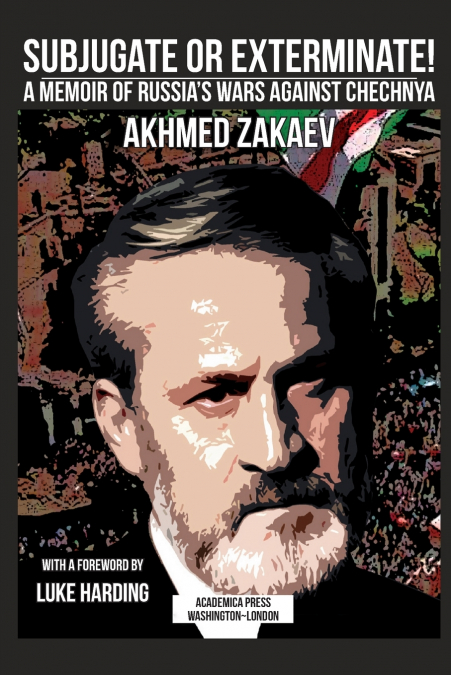
  • Subjugate or exterminate!
    Akhmed Zakaev / Arch Tait
    Foreword by Luke HardingAkhmed Zakaev is a symbol of the indomitable will of the Chechen nation. In this important memoir, he tells the story of the Chechen struggle as he experienced it, describing the conflict in human terms and providing a detailed documentary record of little known or badly understood events that will be of benefit to historians for generations to come.- Da...
    Disponible

    41,63 €