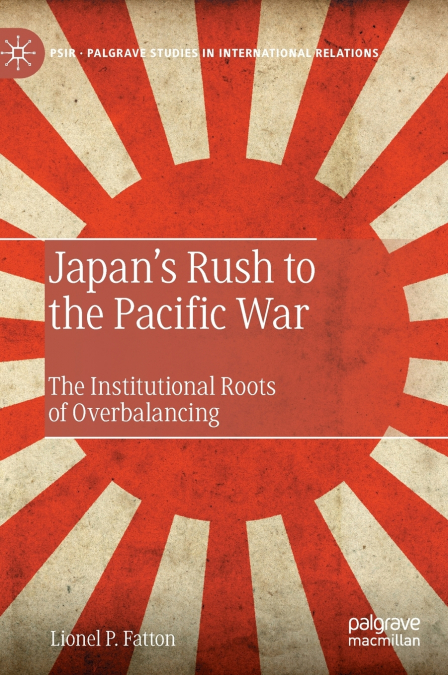

Japan’s Rush to the Pacific War

Japan’s Rush to the Pacific War

Lionel P. Fatton

144,30 €
IVA incluido
Consulta disponibilidad
Editorial:
Springer Nature B.V.
Año de edición:
2023
Materia
Relaciones internacionales
ISBN:
9783031220524

Selecciona una librería:

  • Librería Samer Atenea
  • Librería Aciertas (Toledo)
  • Kálamo Books
  • Librería Perelló (Valencia)
  • Librería Elías (Asturias)
  • Donde los libros
  • Librería Kolima (Madrid)
  • Librería Proteo (Málaga)

This book investigates the phenomenon of overbalancing through an analysis of Japan’s foreign policy during the interbellum. In the mid-1930s, Japan withdrew from a naval arms control framework that had restrained military buildup on both sides of the Pacific Ocean since the early 1920s. By doing so, Japan not only triggered a naval arms race with the United States that exhausted its economy, it also destroyed the last institutionalized structure regulating the relationship between the two Pacific powers. Japan and the United States became caught in a spiral of tensions that culminated with the attack on Pearl Harbor in December 1941. Puzzling is the fact that the international environment in the Asia-Pacific was relatively stable in the mid-1930s, while Washington was pursuing a policy of accommodation toward Tokyo. By rejecting arms control and engaging in unfettered naval expansion, Japan overbalanced against the United States and began its rush to the Pacific War.The book explains Japan’s overbalancing with a neoclassical realist model that combines the literatures on threat perception and civil-military relations. Amid the Manchurian crisis of 1931-1933, as the Japanese government collaborated with the military institution to address the situation in China, military influence on the formulation of foreign policy surged. The perceptual and policy biases of the military, which include the tendency to distrust other countries’ intentions, to adopt worst-case analyses of international dynamics and to strive to maximize military power, gradually penetrated the decision-making process. Dysfunctions in the preexisting structure of Japanese civil-military relations, engendered by an over-depoliticization of the military institution, allowed the navy to convince policymakers that the United States was inherently hostile to Japan, hence the necessity to prepare for war. The government was brainstormed, adopting the biased military perspective on international affairs. Japan overbalanced in a myopic but conscious way.

Artículos relacionados

  • Realism in Practice
    The purpose of this book is to appraise the current relevance and validity of realism as an interpretative tool in contemporary International Relations. All chapters of the book are animated by a theoretical effort to define the conceptual aspects of realism and attempt to establish whether the tradition still provides the necessary conceptual tools to scholars.The chapters add...
    Disponible

    20,36 €

  • Predicting gender violence in India
    Shritha K Vasudevan
    In this provocative new book, Shritha Vasudevan argues that feminist international relations (IR) theory has inadvertently resulted in a biased worldview, the very opposite of what feminist IR set out to try to rectify. This book contests theoretical presumptions of Western feminist IR and attempts to reformulate it in contexts of non-Western cultures. Vasudevan deftly utilizes...
  • Contemporary security issues in Africa
    Isiaka Alani Badmus / Lere Amusan
    In volume, an emerging generation of African scholars examines specific states in Africa where instability is the order of the day. Considerations of African instability are highly relevant in today’s world, where one examines the types of regimes that were put in place after the Cold War and their effects on Africa. Multiparty systems introduced in Africa, rather than bringing...
  • Chronicles of the first and second chechen wars
    Ilya Milyukov
    Presented by Russian author and attorney Ilya Milyukov, Chronicles of the First and Second Chechen War presents the main events of the First (1994-1996) and Second (1999-2009) Wars in Chechnya, Russia’s deadliest conflicts since World War II. The First War began in December 1994 and lasted for one year and nine months, ending in August 1996. There were two major urban battles -...
  • Political instability in Africa
    Isiaka Alani Badmus / Lere Amusan
    This book offers broad-gauged analyses of the causes, nature, and changing patterns of armed conflict in Africa as well as the reasons for these patterns. It also situates conflicts that have been haunting the African continent since the time of decolonization within the various theoretical schools such as 'new war,' 'economic war,' 'neo-patrimonial,' and 'globalization.' It be...
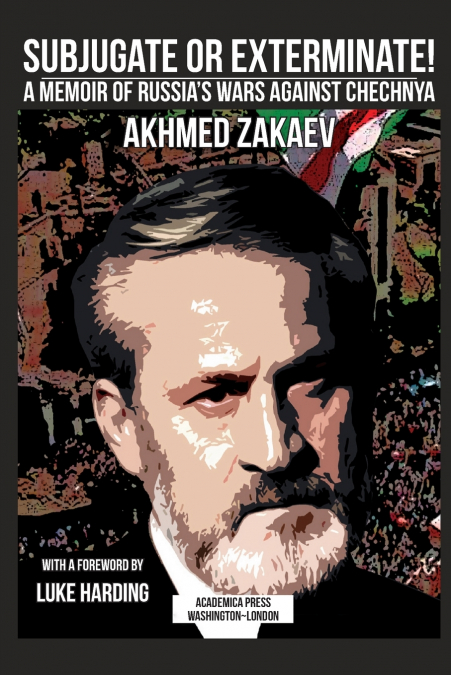
  • Subjugate or exterminate!
    Akhmed Zakaev / Arch Tait
    Foreword by Luke HardingAkhmed Zakaev is a symbol of the indomitable will of the Chechen nation. In this important memoir, he tells the story of the Chechen struggle as he experienced it, describing the conflict in human terms and providing a detailed documentary record of little known or badly understood events that will be of benefit to historians for generations to come.- Da...
    Disponible

    41,63 €

Otros libros del autor

  • Japan’s Rush to the Pacific War
    Lionel P. Fatton
    This book investigates the phenomenon of overbalancing through an analysis of Japan’s foreign policy during the interbellum. In the mid-1930s, Japan withdrew from a naval arms control framework that had restrained military buildup on both sides of the Pacific Ocean since the early 1920s. By doing so, Japan not only triggered a naval arms race with the United States that exhaust...
    Disponible

    47,83 €