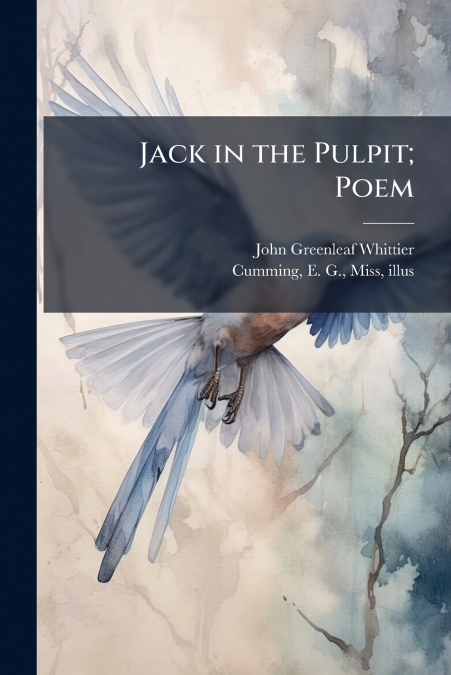
John Greenleaf Whittier / E. G. Miss [from old catalog] Cumming
 Librería Samer Atenea
 Kálamo Books
 Librería Elías (Asturias)
 Librería Kolima (Madrid)
 Librería Proteo (Málaga)
'Jack in the Pulpit; Poem' by John Greenleaf Whittier, accompanied by illustrations, is a charming piece of 19th-century American poetry. Whittier, renowned for his poems celebrating nature, rural life, and abolitionist ideals, turns his attention to the delicate beauty of the Jack-in-the-pulpit flower. This short poem reflects on the spiritual lessons found within the natural world, characteristic of Whittier’s deep connection to both the physical landscape and his Quaker faith.Originally published in 1883, this work captures the serene simplicity of New England’s flora and fauna. Whittier’s accessible verse and gentle observations make this poem an enduring favorite for readers of all ages, offering a peaceful respite and a reminder of the quiet wonders that surround us.This work has been selected by scholars as being culturally important, and is part of the knowledge base of civilization as we know it. This work was reproduced from the original artifact, and remains as true to the original work as possible. Therefore, you will see the original copyright references, library stamps (as most of these works have been housed in our most important libraries around the world), and other notations in the work.This work is in the public domain in the United States of America, and possibly other nations. Within the United States, you may freely copy and distribute this work, as no entity (individual or corporate) has a copyright on the body of the work.As a reproduction of a historical artifact, this work may contain missing or blurred pages, poor pictures, errant marks, etc. Scholars believe, and we concur, that this work is important enough to be preserved, reproduced, and made generally available to the public. We appreciate your support of the preservation process, and thank you for being an important part of keeping this knowledge alive and relevant.