
Inicio > Sociedad y ciencias sociales > Política y gobierno > Relaciones internacionales > Ist eine erfolgreiche Demokratisierung nur bei Bestehen einer freien Marktwirtschaft möglich?
Ist eine erfolgreiche Demokratisierung nur bei Bestehen einer freien Marktwirtschaft möglich?

Ist eine erfolgreiche Demokratisierung nur bei Bestehen einer freien Marktwirtschaft möglich?

Ist eine erfolgreiche Demokratisierung nur bei Bestehen einer freien Marktwirtschaft möglich?

Hans-Jakob Boesch

47,26 €
IVA incluido
Disponible
Editorial:
GRIN Verlag
Año de edición:
2011
Materia
Relaciones internacionales
ISBN:
9783640947454
47,26 €
IVA incluido
Disponible

Selecciona una librería:

  • Librería Samer Atenea
  • Librería Aciertas (Toledo)
  • Kálamo Books
  • Librería Perelló (Valencia)
  • Librería Elías (Asturias)
  • Donde los libros
  • Librería Kolima (Madrid)
  • Librería Proteo (Málaga)

Doktorarbeit / Dissertation aus dem Jahr 2011 im Fachbereich Politik - Internationale Politik - Allgemeines und Theorien, Note: magna cum laude, Universität Zürich, Sprache: Deutsch, Abstract: Bei Diskussionen rund um das Thema Demokratisierungen von Staaten taucht auch die Frage nach der idealen Reihenfolge der Reformen auf: Müssen für eine erfolgreiche Demokratisierung die Reformen am politischen System vor oder nach der Implementierung einer freien Marktwirtschaft erfolgen? In der vorliegenden Arbeit wird argumentiert, dass der Erfolg oder Misserfolg einer Demokratisierung von der Kombination aus der Reihenfolge der Reformen (Reformsequenz) und bestimmten Ausgangsbedingungen abhängt. Konkret wird vermutet, dass die Demokratisierung eines Staates dann erfolgreich verläuft, wenn die Reformen am politischen System vor der Implementierung einer freien Marktwirtschaft erfolgen und dabei eine hohe sozioökonomische Entwicklung, keine gesellschaftlichen Konflikte, starke pro-demokratische Akteure und keine Veto-Player bestehen. Ebenfalls zum Erfolg einer Demokratisierung führt gemäss dieser Annahme, wenn bei der Umsetzung der Reformen des politischen Systems bereits eine freie Marktwirtschaft vorhanden ist. Zur empirischen Überprüfung dieser theoretisch begründeten Kausalbeziehungen zwischen Ausgangsbedingungen, Reformsequenz und Ausgang einer Demokratisierung werden 18 Transformationen auf diese Beziehung hin miteinander verglichen. Diese Querschnittsanalyse wird mit Hilfe der Methode fsQCA (fuzzy-set Qualitative Comparative Analysis) durchgeführt. Die Ergebnisse dieser Analyse zeigen, dass für eine erfolgreiche Demokratisierung idealerweise eine der drei folgenden Konstellationen aus Ausgangsbedingungen und Reformsequenz geben sein sollte: - Bei Beginn der Reformen am politischen System besteht bereits eine freie Marktwirtschaft, d.h. die Wirtschaft-Reformen wurden vor den Reformen am politischen System umgesetzt. - Existieren starke pro-demokratische Akteure und sind

Artículos relacionados

  • Realism in Practice
    The purpose of this book is to appraise the current relevance and validity of realism as an interpretative tool in contemporary International Relations. All chapters of the book are animated by a theoretical effort to define the conceptual aspects of realism and attempt to establish whether the tradition still provides the necessary conceptual tools to scholars.The chapters add...
    Disponible

    20,36 €

  • Predicting gender violence in India
    Shritha K Vasudevan
    In this provocative new book, Shritha Vasudevan argues that feminist international relations (IR) theory has inadvertently resulted in a biased worldview, the very opposite of what feminist IR set out to try to rectify. This book contests theoretical presumptions of Western feminist IR and attempts to reformulate it in contexts of non-Western cultures. Vasudevan deftly utilizes...
  • Contemporary security issues in Africa
    Isiaka Alani Badmus / Lere Amusan
    In volume, an emerging generation of African scholars examines specific states in Africa where instability is the order of the day. Considerations of African instability are highly relevant in today’s world, where one examines the types of regimes that were put in place after the Cold War and their effects on Africa. Multiparty systems introduced in Africa, rather than bringing...
  • Chronicles of the first and second chechen wars
    Ilya Milyukov
    Presented by Russian author and attorney Ilya Milyukov, Chronicles of the First and Second Chechen War presents the main events of the First (1994-1996) and Second (1999-2009) Wars in Chechnya, Russia’s deadliest conflicts since World War II. The First War began in December 1994 and lasted for one year and nine months, ending in August 1996. There were two major urban battles -...
  • Political instability in Africa
    Isiaka Alani Badmus / Lere Amusan
    This book offers broad-gauged analyses of the causes, nature, and changing patterns of armed conflict in Africa as well as the reasons for these patterns. It also situates conflicts that have been haunting the African continent since the time of decolonization within the various theoretical schools such as 'new war,' 'economic war,' 'neo-patrimonial,' and 'globalization.' It be...
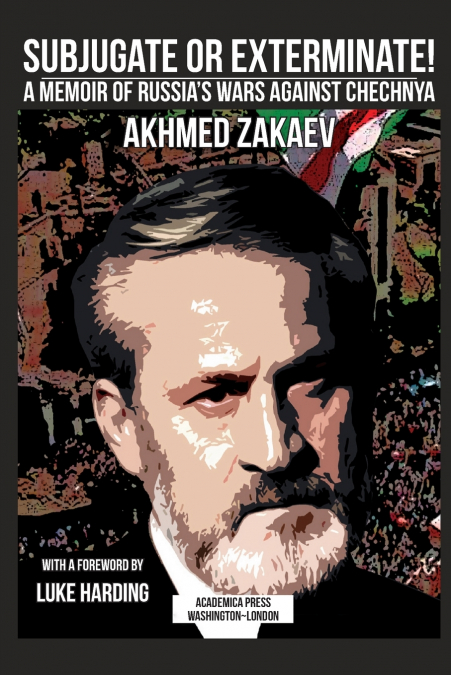
  • Subjugate or exterminate!
    Akhmed Zakaev / Arch Tait
    Foreword by Luke HardingAkhmed Zakaev is a symbol of the indomitable will of the Chechen nation. In this important memoir, he tells the story of the Chechen struggle as he experienced it, describing the conflict in human terms and providing a detailed documentary record of little known or badly understood events that will be of benefit to historians for generations to come.- Da...
    Disponible

    41,63 €