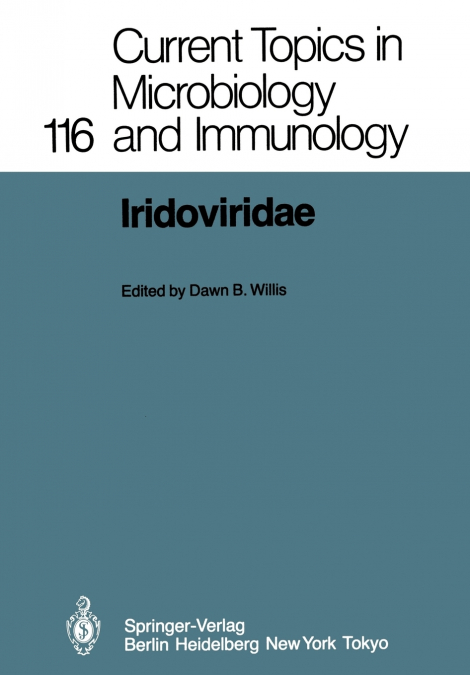

Iridoviridae

Iridoviridae

D.B. Willis

134,41 €
IVA incluido
Disponible
Editorial:
Springer Nature B.V.
Año de edición:
2011
Materia
Inmunología
ISBN:
9783642702822
134,41 €
IVA incluido
Disponible

Selecciona una librería:

  • Librería Samer Atenea
  • Librería Aciertas (Toledo)
  • Kálamo Books
  • Librería Perelló (Valencia)
  • Librería Elías (Asturias)
  • Donde los libros
  • Librería Kolima (Madrid)
  • Librería Proteo (Málaga)

In 1976 the International Committee on Taxonomy of Vi­ ruses (ICTV) created the family Iridoviridae to encompass several different vertebrate and invertebrate viruses that did not fit into any of the other established groups. The unifying features of this new family were (1) polyhedral symmetry; (2) large (approximately 170 kilobase pairs), lin­ ear, double-stranded DNA genomes; and (37) a cytoplas­ mic site of replication. The name 'iridovirus' was derived from the observa­ tion that larvae infected with many of the insect viruses, as well as purified pellets of these viruses, glowed with a blue or green iridescence - presumably due to the Bragg effect of the viral crystals. However, none of the vertebrate 'iridoviruses' displayed this particular characteristic. An attempt was made to substitute the more descriptive name of 'icosahedral cytoplasmic deoxyribovirus', but not only was this term too unwieldy, it also did not conform to the latinized nomenclature the ICTV wished to adopt. So, for both historical and esthetic reasons, 'Iridoviridae' was adopted as a family name, with Iridovirus as the genus represented by the type 1 iridescent insect virus, Tipula iri­ descent virus. At the 1982 ICTV Meeting, enough biochem­ ical data had accumulated to permit the establishment of the following five genera in the family Iridoviridae: English vernacular International Type species name name 1. Small iridescent Iridovirus Tipula iridescent virus insect virus (Type 1) 2. Large iridescent Chloriridovirus Mosquito iridescent insect virus virus (Type 2) 3.

Artículos relacionados

  • Applied Molecular Genetics of Fungi
    British Mycological Society / Peberdy
    ...
  • Horrible Biology
    Arnold Lawson
    Delve into the eerie aspects of nature with this well-illustrated and enlightening book, unveiling the ghastly facets of life that thrive amidst us. From deadly poisonous frogs to plants that can drive one mad, from minuscule spiders residing on the skin to flies feasting on human flesh, and parasitic worms inhabiting human bodies to fungi annihilating frogs - discover these an...
    Disponible

    13,88 €

  • Polar Microbiology
    Polar microbiology is a promising field of research that can tell us much about thefundamental features of life. The microorganisms that inhabit Arctic and Antarcticenvironments are important not only because of the unique species they represent, but alsobecause of their diverse and unusual physiological and biochemical properties. Furthermore,microorganisms living in Polar Reg...
  • Hands-On Experience of Microbial World
    Kyu Hong Cho
    Hands-On Experience of Microbial World: Microbiology Laboratory Exercises provides students with immersive experiences in microbiology.Organized into three comprehensive sections-general microbiology, health-related microbiology, and biotechnology utilizing microorganisms-the exercises cover a diverse range of topics. Students delve into essential techniques such as staining mi...
    Disponible

    85,01 €

  • Prostaglandins, Leukotrienes, and the Immune Response
    John L. Ninneman / John LNinneman / Ninnemann John L.
    ...
    Disponible

    71,64 €

  • Modeling Disease Transmission and Its Prevention by Disinfection
    Hurst Christon J.
    ...
    Disponible

    65,94 €