Inicio > Derecho > Derecho internacional > Iraq and the Use of Force in International Law
Iraq and the Use of Force in International Law

Iraq and the Use of Force in International Law

Marc Weller

96,54 €
IVA incluido
Consulta disponibilidad
Editorial:
Oxford University Press
Año de edición:
2010
Materia
Derecho internacional
ISBN:
9780199595303

Selecciona una librería:

  • Librería Samer Atenea
  • Librería Aciertas (Toledo)
  • Kálamo Books
  • Librería Perelló (Valencia)
  • Librería Elías (Asturias)
  • Donde los libros
  • Librería Kolima (Madrid)
  • Librería Proteo (Málaga)

The prohibition of the use of force is one of the most crucial elements of the international legal order. Our understanding of that rule was both advanced and challenged during the period commencing with the termination of the Iran-Iraq war and the invasion of Kuwait, and concluding with the invasion and occupation of Iraq. The initial phase was characterized by hopes for a functioning collective security system administered by the United Nations as part of a New World Order. The liberation of Kuwait, in particular, was seen by some as a powerful vindication of the prohibition of the use of force and of the UN Security Council. However, the operation was not really conducted in accordance with the requirements for collective security established in the UN Charter. In a second phase, an international coalition launched a humanitarian intervention operation, first in the north of Iraq, and subsequently in the south. That episode is often seen as the fountainhead of the post-Cold War claim to a new legal justification for the use of force in circumstances of grave humanitarian emergency-a claim subsequently challenged during the armed action concerning Kosovo. There then followed repeated uses of force against Iraq in the context of the international campaign to remove its present or future weapons of mass destruction potential. Finally, the episode reached its controversial zenith with the full scale invasion of Iraq led by the US and the UK in 2003. This book analyzes these developments, and their impact on the rule prohibiting force in international relations, in a comprehensive and accessible way. It is the first to draw upon classified materials released by the UK Chilcot inquiry shedding light on the decision to go to war in 2003 and the role played by international law in that context.
Artículos relacionados

  • Comparative regulation, economic analysis, and applications of private equity in the united states and european union
    Irini Liakopoulou
    The present work examines the economics and legal doctrine of private equity. After a consideration of private equity’s origins, the book will explore the evolution of private equity in the United States and Europe. The reference economic model then will be reconstructed, with particular attention to financial flows to and from private equity firms and funds. This reconstructio...
  • Complicity in International Law
    Dimitris Liakopoulous
    Complicity in International Law aims to analyze questions arising from a state’s complicity in conflict with another state or an international organization. On the basis of international legal provisions, a state that assists the illicit fact of another state or an international organization in turn commits an offense if it is aware of the main fact and is bound by the same obl...
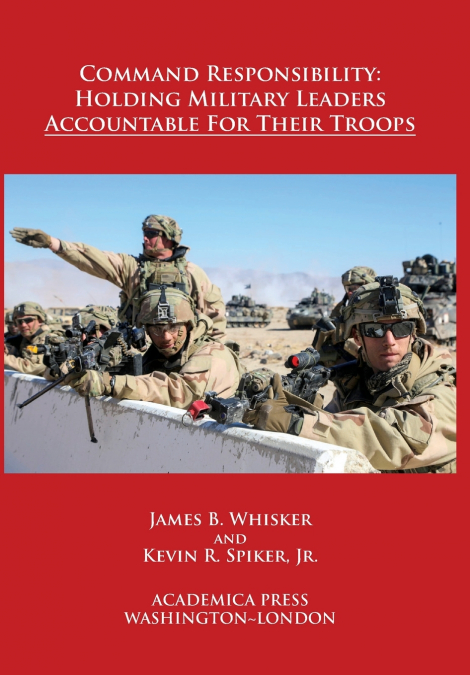
  • Command responsibility
    James B Whisker / Kevin R Spiker
    Command responsibility, or executive accountability, assumes that leaders are responsible for the actions of their subordinates. If subordinates misbehave, violate basic moral laws, transgress international law, or thwart international standards of behavior, their leader may be called before to justice. Standards that set the boundaries of human action have been evolving for ma...
  • International Organizations and Reparations
    Dimitris Liakopoulos
    In the first part of this book, noted legal scholar Dimtris Liakopoulos deals with reconstructing the legal regulatory framework governing human rights violations in the activities of organizations. After identifying rules that are generally applicable to organizations’ offenses and govern the profile of reparations, this study assesses primary rules that guarantee the right to...
  • International Organizations and Legal Sanctions Against Governments
    Dimitris Liakopoulos
    This book examines the relationship between governments and international organizations under international law. After surveying the policing powers of international organizations under international law, it illustrates some normative aspects of law that distinguish regulation from enforcement via study of recent legal cases before international judicial bodies. According to Di...
  • The EU Foreign Subsidies Regulation
    Andreas Reindl / Isabelle Van Damme
    'The EU Foreign Subsidies Regulation' is a pioneering manual authored by legal experts Andreas Reindl and Isabelle Van Damme. This essential guide, the first of its kind, is tailored for legal practitioners, offering a thorough exploration of the tools and mechanisms embedded within this novel European regulatory framework. The authors meticulously dissect the EU Foreign Subsid...

Otros libros del autor