

Archives Départemental D’Eure-et-Loir
 Librería Samer Atenea
 Kálamo Books
 Librería Elías (Asturias)
 Librería Kolima (Madrid)
 Librería Proteo (Málaga)
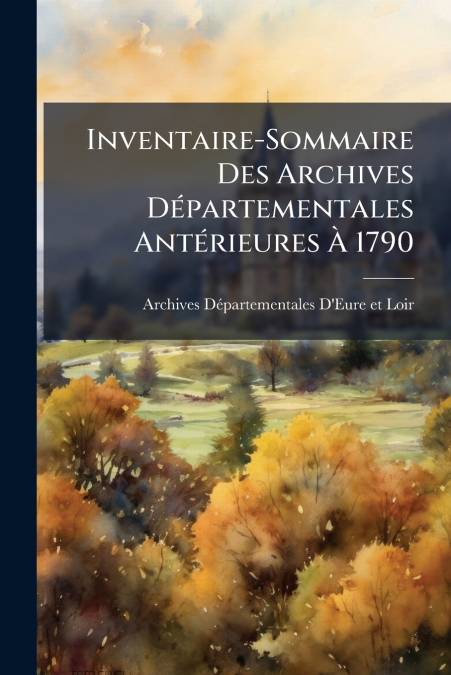
Inventaire-Sommaire Des Archives Départementales Antérieures à 1790 provides a detailed inventory of departmental archives dating before 1790, specifically focusing on civil archives in the Série E collection. Compiled by Archives Départementales D’Eure-et-Loir, this archival resource offers invaluable insights into the legal, administrative, and social structures of France during the Ancien Régime. The inventory serves as a crucial reference for researchers, historians, and genealogists seeking primary source material related to the Eure-et-Loir region. This comprehensive catalogue assists in locating specific documents and understanding the historical context of the records. It covers a wide array of civil documents, offering a rich tapestry of information about pre-revolutionary France. The detailed listings make it an indispensable tool for anyone delving into the history of French law, administration, and society during this pivotal period.This work has been selected by scholars as being culturally important, and is part of the knowledge base of civilization as we know it. This work was reproduced from the original artifact, and remains as true to the original work as possible. Therefore, you will see the original copyright references, library stamps (as most of these works have been housed in our most important libraries around the world), and other notations in the work.This work is in the public domain in the United States of America, and possibly other nations. Within the United States, you may freely copy and distribute this work, as no entity (individual or corporate) has a copyright on the body of the work.As a reproduction of a historical artifact, this work may contain missing or blurred pages, poor pictures, errant marks, etc. Scholars believe, and we concur, that this work is important enough to be preserved, reproduced, and made generally available to the public. We appreciate your support of the preservation process, and thank you for being an important part of keeping this knowledge alive and relevant.





