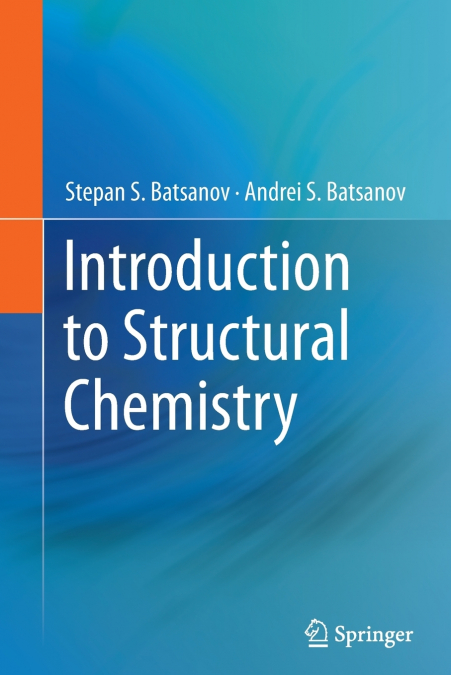
Andrei S. Batsanov / Stepan S. Batsanov
 Librería Samer Atenea
 Kálamo Books
 Librería Elías (Asturias)
 Librería Kolima (Madrid)
 Librería Proteo (Málaga)
1. Atom1.1. Ionization potentials and electron affinities 1.1.1. Ionization potentials of atoms 1.1.2. Electron affinity1.2. Effective nuclear charge1.3. Absolute dimensions of atoms1.4. Radii of atoms in molecules and crystals 1.4.1. Historical outline 1.4.2. Metallic radii 1.4.3. Covalent radii1.5. Radii of ions in molecules and crystals 1.5.1. Methods of estimating ionic radii 1.5.2. Experimental (bonded) ionic radii 1.5.3. Energy-derived ionic radii 1.5.4. Ultimate ionic radii2. Chemical bond2.1. Historical development of the concept2.2. Types of bonds: covalent, ionic, polar, metallic 2.2.1. Ionic bond 2.2.2. Covalent bond 2.2.3. Polar bond, effective charges of atoms 2.2.4. Metallic bond 2.2.5. Effective valences of atoms2.3. Energies of the chemical interactions of atoms 2.3.1. Bond energies in molecules and radicals 2.3.2. Bond energies in crystals 2.3.3. Crystal lattice energies 2.3.4. Band gaps in solids2.4. Concept of electronegativity 2.4.1. Discussion about electronegativity 2.4.2. Thermochemical electronegativities 2.4.3. Ionization electronegativities 2.4.4. Geometrical electronegativities 2.4.5. Recommended system of electronegativities of atoms and radicals 2.4.6. Equalization of electronegativities and atomic charges2.5. Effective charges of atoms and chemical behavior2.6. Change of chemical bond character under pressure2.7. Conclusions3. 'Small' molecule.3.1. Introduction3.2. Inorganic molecules and radicals 3.2.1. Bond distances 3.2.2. Bond angles. VSEPR concept 3.2.3. Non-stoichiometric and unusual molecules 3.3. Organic molecules3.4. Organometallic compounds3.5. Clusters 3.5.1. Boron clusters 3.5.2. Transition metal clusters 3.5.3. Clusters of main group elements 3.5.4. Fullerenes3.6. Coordination compounds4. Intermolecular forces4.1. Van der Waals interaction4.2. Interdependence of the lengths of covalent and van der Waals bonds4.3. Van der Waals radii 4.3.1. Introduction 4.3.2. Crystallographic van der Waals radii 4.3.3. Equilibrium radii of atoms 4.3.4. Anisotropic van der Waals radii 4.3.5. Concluding remarks4.4. Donor-acceptor interactions4.5. Hydrogen bond5. Crystal structure - idealised5.1. Structures of elements 5.1.1. Structures of metals 5.1.2. Structures of non-metals5.2. Binary inorganic crystalline compounds 5.2.1 Crystal structures of halides, oxides, chalcogenides, pnictides 5.2.2 Structures of compounds with diverse bonds5.3. Interconversions of crystal structures5.4. Effective coordination number 5.5. Bond valence (bond strength, bond order) 5.6. Ternary compounds5.7. Structural features of silicates6. Crystal structure - real6.1. Thermal motion6.2. Lindemann’s hypothesis6.3. Defects in crystals 6.3.1. Classification of defects 6.3.2. Defects induced by shock waves 6.3.3. Real structure and melting of solids6.4. Isomorphism and solid solutions7. Amorphous state7.1. Dispersing powders7.2. Amorphous solids, glasses7.3. Structure of melts7.4. Structure of aqueous solutions 8. Between molecule and solid8.1. Energetic properties of clusters and nanoparticles 8.1.1. Melting temperatures and heats under transition from bulk to nanophases 8.1.2. Energy variation under transition from bulk to clusters8.2. Changes of atomic structure on transition from bulk solids to nanophases8.3. Size effect in the dielectric permittivity of crystals 8.3.1. Effect of the energy factor 8.3.2. Effect of the phase c