

 Librería Samer Atenea
 Kálamo Books
 Librería Elías (Asturias)
 Librería Kolima (Madrid)
 Librería Proteo (Málaga)
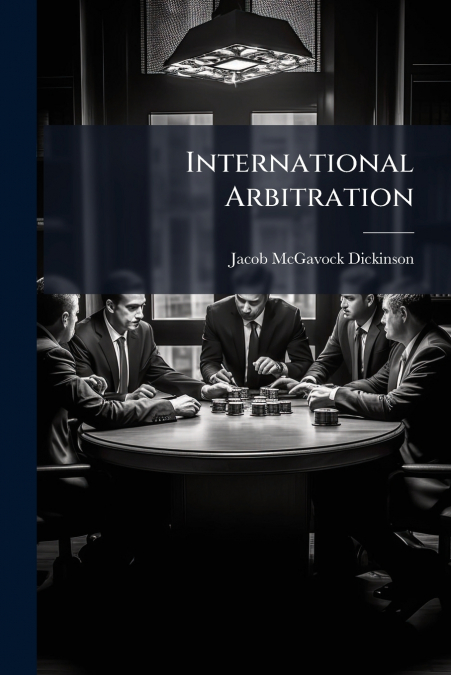
This volume presents Jacob McGavock Dickinson’s address, 'International Arbitration,' delivered before the Literary Societies of Vanderbilt University on June 14, 1904. Dickinson, a prominent lawyer and statesman who later served as Secretary of War under President William Howard Taft, offers a compelling argument for the peaceful resolution of international disputes through arbitration. In this insightful address, Dickinson explores the historical context of arbitration, its potential to prevent war, and its role in fostering global cooperation. He emphasizes the importance of establishing a framework for international law and institutions that can effectively mediate conflicts between nations. Dickinson’s address provides a valuable perspective on the challenges and opportunities of promoting peace in an era of increasing global interconnectedness. This historical document offers insights into the early 20th-century discourse on international relations and the pursuit of a more just and peaceful world.This work has been selected by scholars as being culturally important, and is part of the knowledge base of civilization as we know it. This work was reproduced from the original artifact, and remains as true to the original work as possible. Therefore, you will see the original copyright references, library stamps (as most of these works have been housed in our most important libraries around the world), and other notations in the work.This work is in the public domain in the United States of America, and possibly other nations. Within the United States, you may freely copy and distribute this work, as no entity (individual or corporate) has a copyright on the body of the work.As a reproduction of a historical artifact, this work may contain missing or blurred pages, poor pictures, errant marks, etc. Scholars believe, and we concur, that this work is important enough to be preserved, reproduced, and made generally available to the public. We appreciate your support of the preservation process, and thank you for being an important part of keeping this knowledge alive and relevant.





