 Librería Samer Atenea
 Kálamo Books
 Librería Elías (Asturias)
 Librería Kolima (Madrid)
 Librería Proteo (Málaga)
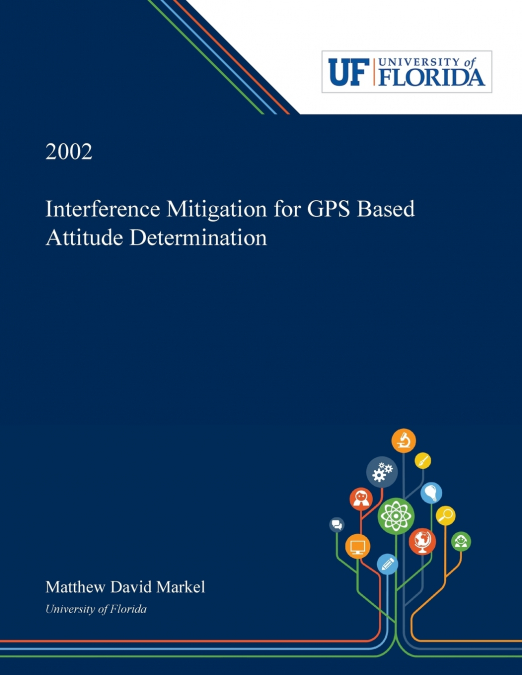
Abstract:With its low transmit power and considerable orbit distance from receivers, the Global positioning system (GPS) waveforms are known to be susceptible to jamming. Efforts to date have investigated various receiver designs and adaptive antenna arrays to improve the anti-jam capabilities of GPS position location, but until this work no extension of anti-jam capabilities to attitude determination (determination of the orientation of a body in space) existed. This dissertation provides a comprehensive investigation into the new field of robust, jam-resistant attitude determination using the Global Positioning System. We present a generic adaptive antenna array and receiver design that provide the necessary data for both position location and attitude determination in a jammed environment. Using the data this receiver provides we develop a new maximum likelihood attitude estimator (the MLAE) that provides attitude determination capability even in jammed environments. In order to accomplish this, new ways of viewing the standard array processing and direction finding tenants are presented. This leads to a new interpretation and parameterization of the array response vector (spatial steering vector) and secondary data covariance matrix. The MLAE optimally includes information from all satellites in view, and its performance is shown herein to asymptotically achieve the Cramer-Rao Bound (CRB), i.e. the MLAE asymptotically achieves the performance limit for unbiased estimators. As an approximation to this estimator, a second estimator is developed that, at the expense of performance, may provide increased computational capability. Two versions of this second estimator are presented that combine direction ¯nding with attitude estimation. A method of optimally incorporating data from both GPS frequencies into the estimation is developed. This approach maintains the jammer mitigation capabilities of the previous estimators and allows for a larger array spacing, therefore increasing the accuracy of the attitude estimates. Simulation based performance results of the various estimators are presented for various antenna topologies and interference scenarios. The simulation results indicate that the new algorithms provide signicant improvement over conventional attitude determination methods. In addition, the MLAE is shown to provide better performance than conventional methods of attitude determination even in unjammed environments.Dissertation Discovery Company and University of Florida are dedicated to making scholarly works more discoverable and accessible throughout the world. This dissertation, 'Interference Mitigation for GPS Based Attitude Determination' by Matthew David Markel, was obtained from University of Florida and is being sold with permission from the author. A digital copy of this work may also be found in the university’s institutional repository, IR@UF. The content of this dissertation has not been altered in any way. We have altered the formatting in order to facilitate the ease of printing and reading of the dissertation.