 Librería Samer Atenea
 Kálamo Books
 Librería Elías (Asturias)
 Librería Kolima (Madrid)
 Librería Proteo (Málaga)
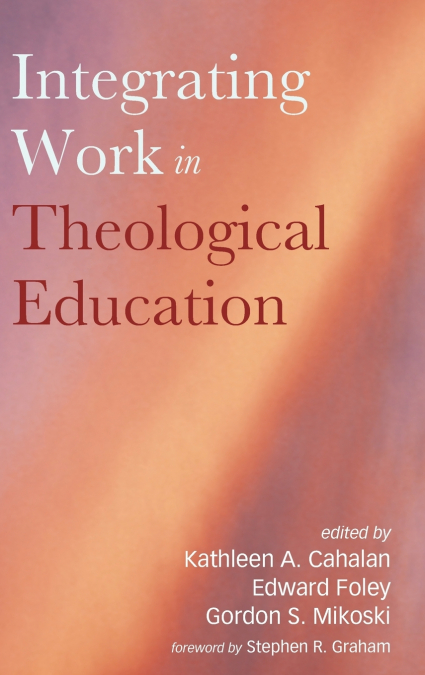
If only we could do a better job of helping students at ''connecting the dots,'' theological educators commonly lament. Integration, often proposed as a solution to the woes of professional education for ministry, would help students integrate knowledge, skills, spirituality, and integrity. When these remain disconnected, incompetence ensues, and the cost runs high for churches, denominations, and ministers themselves. However, we fail in thinking that integrating work is for students alone. It is a multifaceted, constructive process of learning that is contextual, reflective, and dialogical. It aims toward important ends--competent leaders who can guide Christian communities today. It entails rhythms, not stages, and dynamic movement, including disintegration. Integrating work is learning in motion, across domains, and among and between persons. It is social and communal, born of a life of learning together for faculty, staff, administrators and students. It is work that bridges the long-standing gaps between school, ministry practice, and life. It’s a verb, not a noun. Here a diverse group of theological educators, through descriptive case studies, theological reflection, and theory building, offer a distinctive contribution to understanding integrating work and how best to achieve it across three domains: in community, curriculums, and courses.''For the past several decades, discussions within theological education have offered integration as the antidote for what ails it. In this collaboratively authored book, the discussion finally takes on clarity and depth as the authors study institutional and ministerial contexts, a wide array of curricula, and various case studies to draw out the meanings and implications of a way of learning that integrates theory and practice, academic and ministerial contexts, and conceptual and professional models. An excellent way to frame and inform the ongoing discussions.''--Nadine S. Pence, Executive Director, Wabash Center ''The primary way schools do their work is to divide large subject areas into smaller parts. The primary way that pastors do their work is to combine information from multiple sources. The perennial challenge for theological educators is to connect the parts that schools use with the integrated combinations that pastors use. Integrating Work in Theological Education addresses this very issue thoughtfully and comprehensively, and does so more effectively than any resource I have ever read.''--Daniel Aleshire, Executive Director, Association of Theological Schools in the United States and Canada''In our time the world is hyper-connected, yet painfully fragmented. All of us--ministers, seminary professors, students, and people of faith--need portals for imagining and enacting whole and healed ways to be in the world. Cahalan, Foley, and Mikoski, with their colleagues, offer us keys to integration, ’a dynamic process that evolves over time.’ The book ushers us into new ways to embrace integrating work in classrooms, ministry settings, and even faculty meetings.''--Eileen R. Campbell-Reed, author of Anatomy of a Schism: How Clergywomen’s Narratives Reinterpret the Fracturing of the Southern Baptist Convention''This kind of book is both long overdue, and, for that reason, deeply needed. Generations of research on theological education (Farley, Kelsey, Foster) have pointed to the dis-integrating character of traditional patterns of theological education. This book offers a rich (and integrated!) discussion of how to change these patterns. Staff, faculty, administration, trustees, and church leaders involved in forming faith leaders should read, discuss, and enact changes based upon this energetic, collaborative book.''--Christian Scharen, The Center for the Study of Theological Education, Auburn Theological SeminaryKathleen A. Cahalan, Professor of Practical Theology at Saint John’s School of Theology and Seminary, is coeditor of Calling in Today