Juan Vicente Güémez Pacheco De Padilla
 Librería Samer Atenea
 Librería Aciertas (Toledo)
 Kálamo Books
 Librería Perelló (Valencia)
 Librería Elías (Asturias)
 Donde los libros
 Librería Kolima (Madrid)
 Librería Proteo (Málaga)
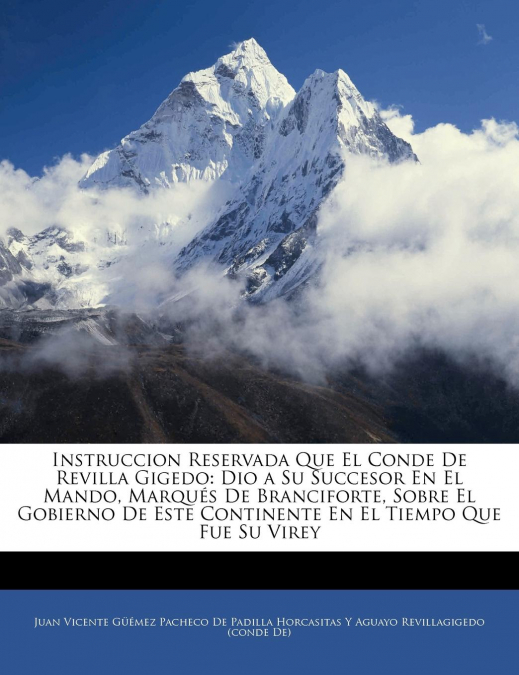
Instruccion Reservada Que El Conde De Revilla Gigedo Dio a Su Succesor En El Mando, Marqués De Branciforte, Sobre El Gobierno De Este Continente En El Tiempo Que Fue Su Virey offers a detailed view into the governance of the Spanish viceroyalty in the late 18th century. Penned by Juan Vicente Güémez Pacheco de Padilla Horcasitas y Aguayo, Conde de Revilla Gigedo, this document provides invaluable insights into the challenges and strategies involved in administering the vast territories of New Spain. Addressed to his successor, the Marqués de Branciforte, the instruction covers a range of topics pertinent to the political, economic, and social landscape of the era.This historical document sheds light on the policies, concerns, and administrative practices of the Spanish colonial government, revealing the complexities of maintaining control and order in a distant and diverse territory. For historians and scholars of Latin America, colonial Mexico, and Spanish administration, this work is an essential primary source that illuminates the inner workings of one of history’s most influential colonial empires.This work has been selected by scholars as being culturally important, and is part of the knowledge base of civilization as we know it. This work was reproduced from the original artifact, and remains as true to the original work as possible. Therefore, you will see the original copyright references, library stamps (as most of these works have been housed in our most important libraries around the world), and other notations in the work.This work is in the public domain in the United States of America, and possibly other nations. Within the United States, you may freely copy and distribute this work, as no entity (individual or corporate) has a copyright on the body of the work.As a reproduction of a historical artifact, this work may contain missing or blurred pages, poor pictures, errant marks, etc. Scholars believe, and we concur, that this work is important enough to be preserved, reproduced, and made generally available to the public. We appreciate your support of the preservation process, and thank you for being an important part of keeping this knowledge alive and relevant.