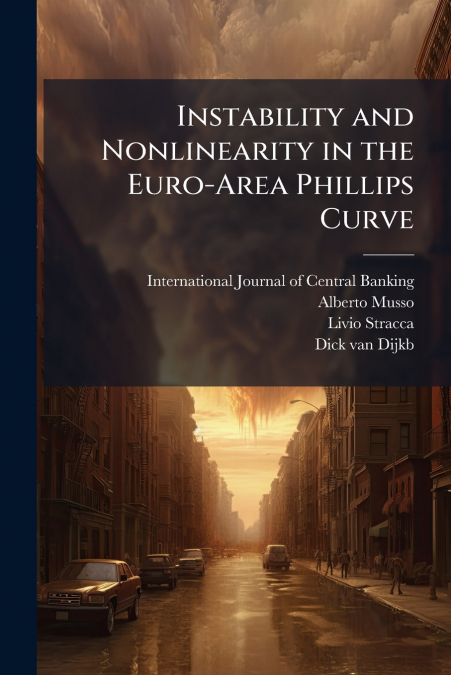
Alberto Musso / Livio Stracca / International Journal of Central Banking
 Librería Samer Atenea
 Kálamo Books
 Librería Elías (Asturias)
 Librería Kolima (Madrid)
 Librería Proteo (Málaga)
This paper provides a comprehensive analysis of the functional form of the euro-area Phillips curve over the past three decades. In particular, compared with previous literature, we analyze the stability of the relationship in detail, especially as regards the possibility of a time-varying mean of inflation. Moreover, we conduct a sensitivity analysis across different measures of economic slack. Our main findings are two. First, there is strong evidence of time variation in the mean and slope of the Phillips curve occurring in the early to mid-1980s, but not in inflation persistence once the mean shift is allowed for. As a result of the structural change, the Phillips curve became flatter around a lower mean of inflation. Second, we find no significant evidence of nonlinearity - in particular, in relation to the output gap.This work has been selected by scholars as being culturally important, and is part of the knowledge base of civilization as we know it. This work was reproduced from the original artifact, and remains as true to the original work as possible. Therefore, you will see the original copyright references, library stamps (as most of these works have been housed in our most important libraries around the world), and other notations in the work.This work is in the public domain in the United States of America, and possibly other nations. Within the United States, you may freely copy and distribute this work, as no entity (individual or corporate) has a copyright on the body of the work.As a reproduction of a historical artifact, this work may contain missing or blurred pages, poor pictures, errant marks, etc. Scholars believe, and we concur, that this work is important enough to be preserved, reproduced, and made generally available to the public. We appreciate your support of the preservation process, and thank you for being an important part of keeping this knowledge alive and relevant.