
Inorganometallic Chemistry

Inorganometallic Chemistry

Thomas P. Fehlner

205,98 €
IVA incluido
Disponible
Editorial:
Springer Nature B.V.
Año de edición:
1992
ISBN:
9780306439865
205,98 €
IVA incluido
Disponible

Selecciona una librería:

  • Librería Samer Atenea
  • Librería Aciertas (Toledo)
  • Kálamo Books
  • Librería Perelló (Valencia)
  • Librería Elías (Asturias)
  • Donde los libros
  • Librería Kolima (Madrid)
  • Librería Proteo (Málaga)

There is a certain fascination associated with words. The manipulation of strings of symbols according to mutually accepted rules allows a language to express history as well as to formulate challenges for the future. But language changes as old words are used in a new context and new words are created to describe changing situations. How many words has the computer revolution alone added to languages? 'Inorganometallic' is a word you probably have never encountered before. It is one created from old words to express a new presence. A strange sounding word, it is also a term fraught with internal contradiction caused by the accepted meanings of its constituent parts. 'In­ organic' is the name of a discipline of chemistry while 'metallic' refers to a set of elements constituting a subsection of that discipline. Why then this Carrollian approach to entitling a set of serious academic papers? Organic, the acknowledged doyenne of chemistry, is distinguished from her brother, inorganic, by the prefix 'in,' i. e. , he gets everything not organic. Organometallic refers to compounds with carbon-metal bonds. It is simple! Inorganometallic is everything else, i. e. , compounds with noncarbon-metal element bonds. But why a new term? Is not inorganic sufficient? By virtue of training, limited time, resources, co-workers, and so on, chemists tend to work on a specific element class, on a particular compound type, or in a particular phase. Thus, one finds element-oriented chemists (e. g.
Artículos relacionados

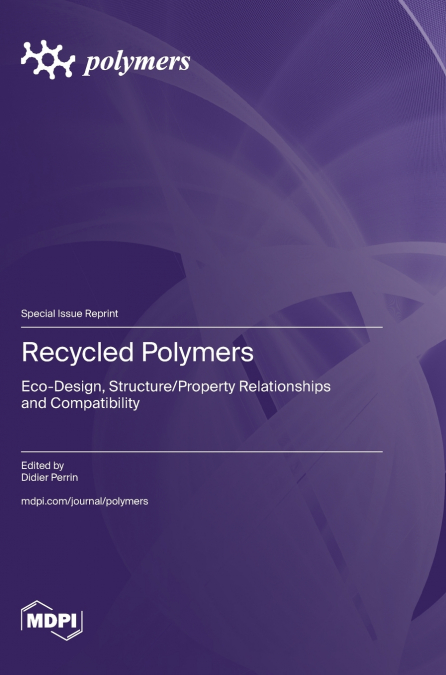
  • Recycled Polymers
    Didier Perrin
    The efficient ecodesign of secondary raw materials from recycled multiphase polymer systems is performed through the study of various things, such as:The compatibility of mixtures of recycled polymers where work on knowledge of the miscibility of mixtures depends on the different rates and the nature of the constituents;The aging of recycled polymers in terms of the structuring...
    Disponible

    79,51 €

  • Advanced Nanoscale Materials for Thermoelectric Applications
    This Special Issue covers preparations, measurements, devices, and applications based on thermoelectric nanomaterials and summarizes the latest developments towards highly efficient thermoelectric nanomaterials and thermoelectric devices. ...
    Disponible

    60,44 €

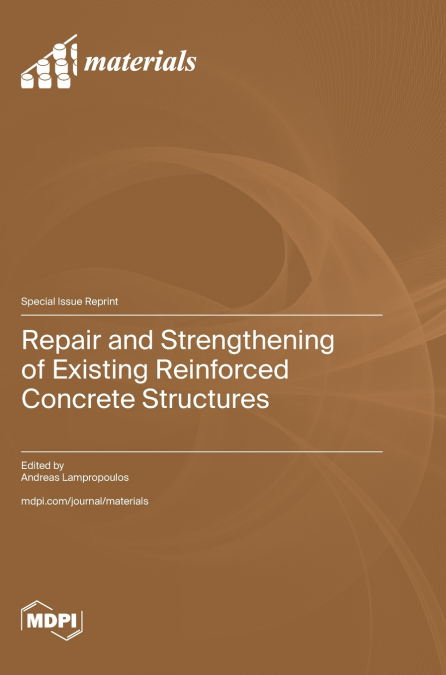
  • Repair and Strengthening of Existing Reinforced Concrete Structures
    Andreas Lampropoulos
    It is crucial that we strengthen existing structures worldwide, especially in earthquake-prone areas. Recent earthquakes have highlighted the inadequacy of many existing structures, which have been damaged from previous powerful earthquakes and have been designed without code provisions or according to old code provisions that are now obsolete. Furthermore, the majority of exis...
    Disponible

    98,52 €

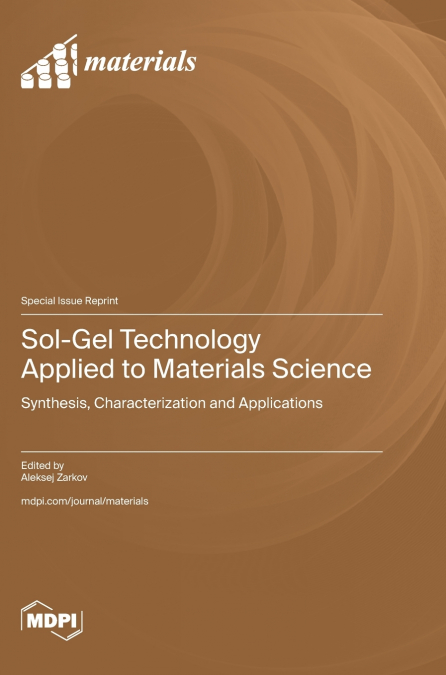
  • Sol-Gel Technology Applied to Materials Science
    Aleksej Zarkov
    Rapid advances in technologies around the globe necessitate the development of new materials, nanostructures, and multicomponent composites with specific chemical and physical properties that can meet the requirements of modern technologies. Using appropriate synthetic approaches is crucial for the preparation of inorganic materials with designed microstructure and properties. ...
    Disponible

    69,92 €

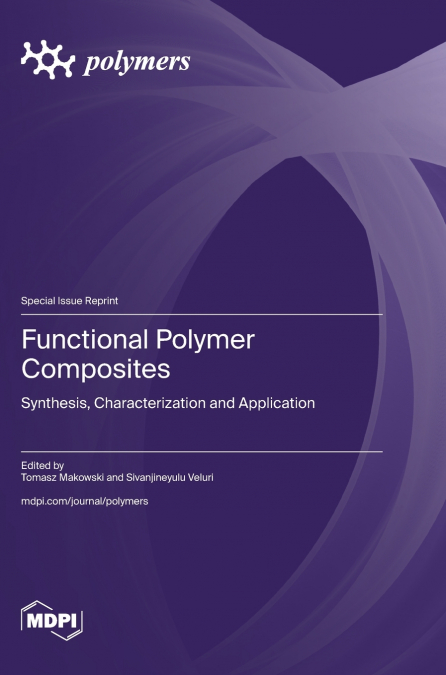
  • Functional Polymer Composites
    Functional polymer composites are showing increasing potential as materials in chemistry and materials science. Polymer composites, including nanocomposites, are made via the incorporation of fillers in polymer matrices and offer many advantages. The properties of polymer composites are further improved via the surface modification of fillers or the matrix phase. Currently, the...
    Disponible

    69,97 €

  • Feature Papers in Section Biosensors 2023
    Evgeny Katz
    This reprint, based on the Special Issue, provides a general overview of different biosensors, briefly explaining the general approaches to identifying them, their construction, and their performance. A discussion concerning how the required components of biosensors are combined to perform analytical work is presented. Different signal-transducing mechanisms are discussed, part...
    Disponible

    79,48 €

Otros libros del autor

  • Inorganometallic Chemistry
    Thomas P. Fehlner
    There is a certain fascination associated with words. The manipulation of strings of symbols according to mutually accepted rules allows a language to express history as well as to formulate challenges for the future. But language changes as old words are used in a new context and new words are created to describe changing situations. How many words h...
    Disponible

    207,10 €