 Librería Samer Atenea
 Kálamo Books
 Librería Elías (Asturias)
 Librería Kolima (Madrid)
 Librería Proteo (Málaga)
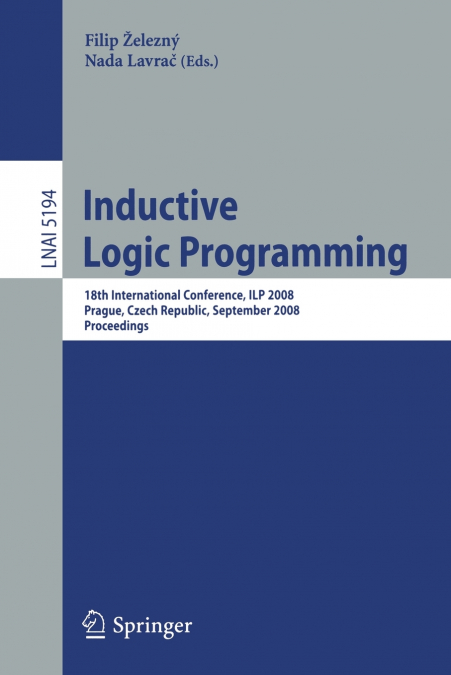
The 18th International Conference on Inductive Logic Programming was held in Prague, September 10-12, 2008. ILP returned to Prague after 11 years, and it is tempting to look at how the topics of interest have evolved during that time. The ILP community clearly continues to cherish its beloved ?rst-order logic representation framework. This is legitimate, as the work presented at ILP 2008 demonstrated that there is still room for both extending established ILP approaches (such as inverse entailment) and exploring novel logic induction frameworks (such as brave induction). Besides the topics lending ILP research its unique focus, we were glad to see in this year’s proceedings a good n- ber of papers contributing to areas such as statistical relational learning, graph mining, or the semantic web. To help open ILP to more mainstream research areas, the conference featured three excellent invited talks from the domains of the semantic web (Frank van Harmelen), bioinformatics (Mark Craven) and cognitive sciences (Josh Tenenbaum). We deliberately looked for speakers who are not directly involved in ILP research. We further invited a tutorial on stat- tical relational learning (Kristian Kersting) to meet the strong demand to have the topic presented from the ILP perspective. Lastly, Stefano Bertolo from the European Commission was invited to give a talk on the ideal niches for ILP in the current EU-supported research on intelligent content and semantics.