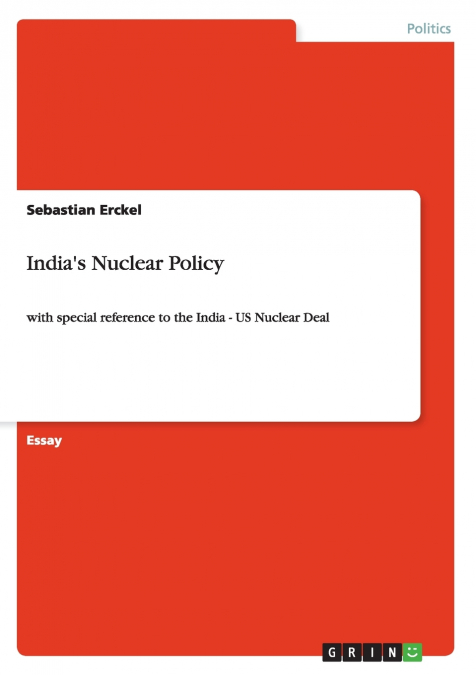

India’s Nuclear Policy

India’s Nuclear Policy

Sebastian Erckel

25,42 €
IVA incluido
Disponible
Editorial:
GRIN Verlag
Año de edición:
2009
Materia
Diplomacia
ISBN:
9783640327362
25,42 €
IVA incluido
Disponible

Selecciona una librería:

  • Librería Samer Atenea
  • Librería Aciertas (Toledo)
  • Kálamo Books
  • Librería Perelló (Valencia)
  • Librería Elías (Asturias)
  • Donde los libros
  • Librería Kolima (Madrid)
  • Librería Proteo (Málaga)

Essay from the year 2008 in the subject Politics - Region: South Asia, grade: 80%= good, University of Kerala (Department of Political Science), course: India’s Foreign Policy, language: English, abstract: This essay presents an outline of the evolution of India’s Nuclear Policy with a special reference to the India- US Nuclear Deal.However, more recent developments such as the passing of the Deal, withdrawal of Left support and the vote of confidence in the Lok Sabha are not included. On April 8th 2008 The Hindu published an article titled 'Potential consequences of a regionalnuclear conflict' in which the author convincingly illustrates the dangers a nuclear- armedSouth Asia presents.1 The fact that both India and Pakistan, but of course also China,possess nuclear weapons has been an alarming reality since 1998. The relative progressthat has been achieved in India- Pakistan relations should not lead one to forget that twoconflicts in 1999 and 2001 could easily have escalated into a nuclear confrontation.India had embarked upon a civilian nuclear program right after her independence but the'weapon option' has always been present. India’s nuclear policy has been an evolutionary,sometimes painful process equally shaped by domestic and international factors. This paperattempts to analyse some of these factors and argues that the development of nuclearweapons was a logical, albeit not planned, consequence of them. It is interesting that eventhose in India fiercely opposed to nuclear weapons subconsciously seemed to have realisedthat India’s nuclear program could not be limited to civilian application forever.A constant in India’s nuclear policy is the strong wish to become and remain as independentas possible. For this independent nuclear policy India had to pay a high price. Isolated frominternational nuclear cooperation, confronted with sharp criticism and even sanctions, Indiahad to rely on herself. While India’s success has been a great source of n
Artículos relacionados

  • How Statesmen Think
    Robert Jervis
    Robert Jervis has been a pioneering leader in the study of the psychology of international politics for more than four decades. How Statesmen Think presents his most important ideas on the subject from across his career. This collection of revised and updated essays applies, elaborates, and modifies his pathbreaking work. The result is an indispensable book for students and sch...
    Disponible

    43,09 €

  • Tower of Babble
    Dore Gold
    ...
    Disponible

    16,40 €

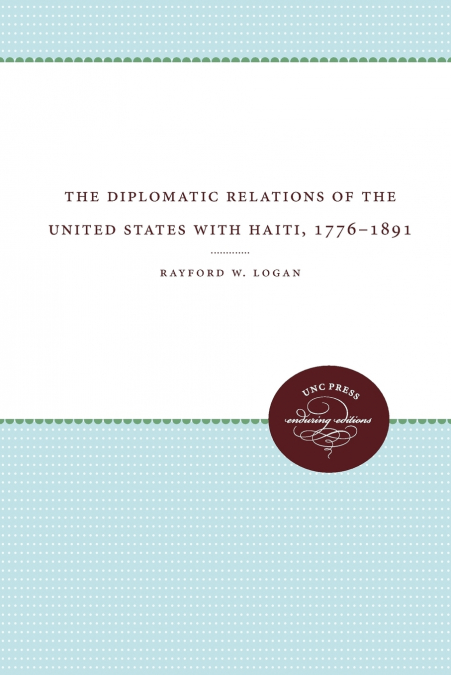
  • The Diplomatic Relations of the United States with Haiti, 1776-1891
    Rayford W. Logan
    The relations of the United States with Haiti have been different from American relations with any other nation; they have been vital and at times even dramatic. They climaxed in 1891 when the United States failed to make Haiti lease her Mole St. Nicolas. This failure constitutes an amazing episode in American diplomatic hostory. Recounting the story of Haiti’s struggle for ind...
    Disponible

    76,25 €

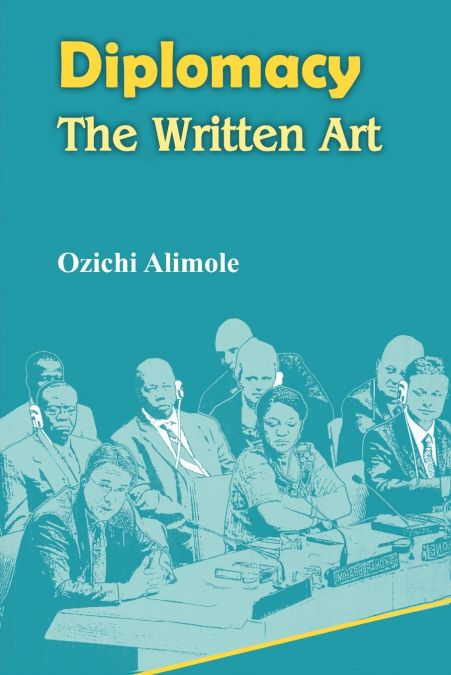
  • Diplomacy. the Written Art
    Ozichi Alimole
    The author seeks to redefine written diplomacy in its true meaning: the art of learning to write in a particular kind of language and mood. He seeks to refocus attention on the significance of diplomatic communication as one of the defining characteristics of diplomacy. A wide variety of correspondence encountered by diplomats is explained, with an analysis of each form of corr...
    Disponible

    57,94 €

  • West Africa’s Trouble Spots and the Impe
    Osita Agbu
    This monograph highlights the necessity for taking preventive measures in the form of peace-building as a sustainable and long-term solution to conflicts in West Africa, with a special focus on the Mano River Union countries. Apart from the Mano River Union countries, efforts at resolving other conflicts in say, Guinea Bissau, Senegal, Côte d’Ivoire and Nigeria, have suffered f...
    Disponible

    58,17 €

  • The Evolution Of UAE Foreign Policy
    GEW Intelligence Unit
    The research background of this book focuses on the historical evolution and strategic development of the United Arab Emirates’ (UAE) foreign policy from its formation to the present day.u2029The research methodology proposed in this book includes a historical analysis of the UAE’s foreign policy, examining key events and strategies that have shaped its current principles and g...
    Disponible

    28,96 €

Otros libros del autor

  • Public Administration in the Age of Globalization
    Sebastian Erckel
    Essay from the year 2007 in the subject Politics - Miscellaneous, grade: 80%=good, University of Kerala (Department of Political Science), course: Theories and Concepts of Public Administration, language: English, abstract: This essay analyses the impact of globalisation on Public Administration in its practical application and as an academic discipline. ...
    Disponible

    18,43 €

  • Development and Impact of Postmodernism
    Sebastian Erckel
    Essay from the year 2008 in the subject Politics - Political Theory and the History of Ideas Journal, grade: 80%=good, University of Kerala (Department of Political Science), course: Modern Political Analysis, language: English, abstract: Few people would deny that they are living in an age of great transformational processes. For centuries, if not millennia, the changes in hum...
    Disponible

    18,24 €