
Inicio > Derecho > Derecho internacional > In What Ways has US Security Cooperation Programs Been Effective in Helping Kenya to Build Partnership Capacity to Counter Transnational Terrorism?
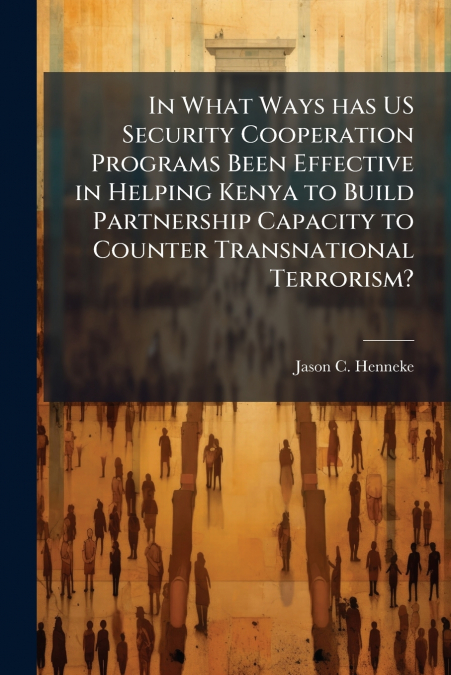
In What Ways has US Security Cooperation Programs Been Effective in Helping Kenya to Build Partnership Capacity to Counter Transnational Terrorism?

In What Ways has US Security Cooperation Programs Been Effective in Helping Kenya to Build Partnership Capacity to Counter Transnational Terrorism?

Jason C. Henneke

17,41 €
IVA incluido
Disponible
Editorial:
BiblioScholar
Año de edición:
2012
Materia
Derecho internacional
ISBN:
9781288257430
17,41 €
IVA incluido
Disponible

Selecciona una librería:

  • Librería Samer Atenea
  • Librería Aciertas (Toledo)
  • Kálamo Books
  • Librería Perelló (Valencia)
  • Librería Elías (Asturias)
  • Donde los libros
  • Librería Kolima (Madrid)
  • Librería Proteo (Málaga)

This monograph uses Kenya as a case study to analyze the US Security Cooperation role and process in building host-nation capacity to meet the needs of Kenya to counter transnational terrorists’ networks. US counterterrorism operations since 9/11 have explicitly demonstrated the US requirement to take an indirect approach to ensuring national security as part of an international community combating transnational terrorists’ networks. In addition to capacity building, regional focus from all agencies with the US Government (USG) is required for a coordinated and effective approach in the GWOT. The United States began formal relations with Kenya in 1981 with air and port basing agreements. Kenya’s strategic location facilitated access for stability and humanitarian operations in the western Indian Ocean and east Africa. The events of 9/11 highlighted the US requirement for security partners in combating transnational terrorists and Kenya became a central front on the Global War on Terror (GWOT) due to its strategic location and willingness to ally. The partnership that started during the Cold War has carried on through to today’s war on transnational terrorists. Kenya is one of the three 'anchor states' in sub-Saharan Africa, along with Nigeria and South Africa, essential in stabilizing Africa. The program with Kenya focused on three general lines of effort to include foreign assistance, defense security cooperation and assistance programs, and counter-terrorism training programs. In general, all three have been effective for Kenya. In specifics, the lack of a coordinated regional USG effort reduced the effectiveness of on-going programs to counter the transnational threat in the region. The nature of capacity building and countering terrorism requires a long-term strategy. The requirement to get initial successes in short and mid-term are met through the Defense and Counter-Terrorism efforts. The success in these areas is due to tailoring these programs to the requiThis work has been selected by scholars as being culturally important, and is part of the knowledge base of civilization as we know it. This work was reproduced from the original artifact, and remains as true to the original work as possible. Therefore, you will see the original copyright references, library stamps (as most of these works have been housed in our most important libraries around the world), and other notations in the work.This work is in the public domain in the United States of America, and possibly other nations. Within the United States, you may freely copy and distribute this work, as no entity (individual or corporate) has a copyright on the body of the work.As a reproduction of a historical artifact, this work may contain missing or blurred pages, poor pictures, errant marks, etc. Scholars believe, and we concur, that this work is important enough to be preserved, reproduced, and made generally available to the public. We appreciate your support of the preservation process, and thank you for being an important part of keeping this knowledge alive and relevant.
Artículos relacionados

  • Comparative regulation, economic analysis, and applications of private equity in the united states and european union
    Irini Liakopoulou
    The present work examines the economics and legal doctrine of private equity. After a consideration of private equity’s origins, the book will explore the evolution of private equity in the United States and Europe. The reference economic model then will be reconstructed, with particular attention to financial flows to and from private equity firms and funds. This reconstructio...
  • Complicity in International Law
    Dimitris Liakopoulous
    Complicity in International Law aims to analyze questions arising from a state’s complicity in conflict with another state or an international organization. On the basis of international legal provisions, a state that assists the illicit fact of another state or an international organization in turn commits an offense if it is aware of the main fact and is bound by the same obl...
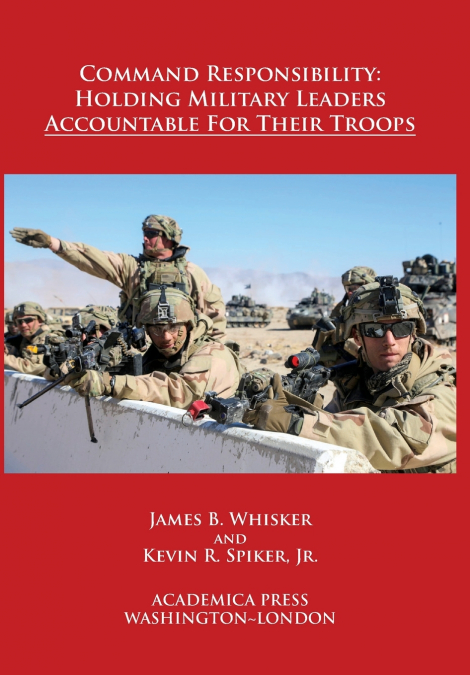
  • Command responsibility
    James B Whisker / Kevin R Spiker
    Command responsibility, or executive accountability, assumes that leaders are responsible for the actions of their subordinates. If subordinates misbehave, violate basic moral laws, transgress international law, or thwart international standards of behavior, their leader may be called before to justice. Standards that set the boundaries of human action have been evolving for ma...
  • International Organizations and Reparations
    Dimitris Liakopoulos
    In the first part of this book, noted legal scholar Dimtris Liakopoulos deals with reconstructing the legal regulatory framework governing human rights violations in the activities of organizations. After identifying rules that are generally applicable to organizations’ offenses and govern the profile of reparations, this study assesses primary rules that guarantee the right to...
  • International Organizations and Legal Sanctions Against Governments
    Dimitris Liakopoulos
    This book examines the relationship between governments and international organizations under international law. After surveying the policing powers of international organizations under international law, it illustrates some normative aspects of law that distinguish regulation from enforcement via study of recent legal cases before international judicial bodies. According to Di...
  • The EU Foreign Subsidies Regulation
    Andreas Reindl / Isabelle Van Damme
    'The EU Foreign Subsidies Regulation' is a pioneering manual authored by legal experts Andreas Reindl and Isabelle Van Damme. This essential guide, the first of its kind, is tailored for legal practitioners, offering a thorough exploration of the tools and mechanisms embedded within this novel European regulatory framework. The authors meticulously dissect the EU Foreign Subsid...