

Dr. Aanchal / Dr. Ravudai Singh Jabbal / Dr. Reeta Jain
 Librería Samer Atenea
 Kálamo Books
 Librería Elías (Asturias)
 Librería Kolima (Madrid)
 Librería Proteo (Málaga)
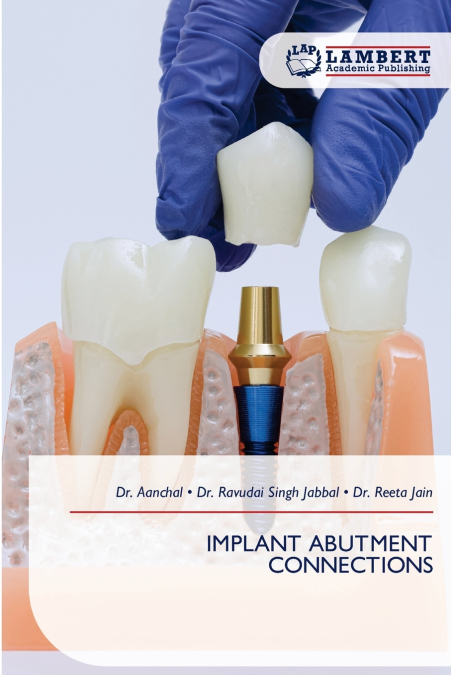
An ideal implant-abutment connection should provide mechanical stability, resist functional loading, minimize micromovement, prevent screw loosening, and reduce bacterial leakage. It should also help maintain peri-implant tissue health and preserve crestal bone levels. The primary functions of the connection are to maintain abutment positioning, distribute occlusal forces, resist rotational and lateral movements, and minimize the passage of microorganisms through the interface. The implant-abutment connection is fundamental to the mechanical stability and biological performance of dental implants. External hexagonal connections offer simplicity and extensive clinical experience, while internal hexagonal connections provide improved indexing and lateral stability. Internal conical and Morse taper connections generally demonstrate favourable mechanical behaviour and may reduce microleakage and marginal bone changes in certain clinical situations. However, long-term implant success depends on more than connection design. Appropriate implant positioning, prosthetic planning, occlusal management, oral hygiene, and peri-implant tissue maintenance are equally important.





