 Librería Samer Atenea
 Kálamo Books
 Librería Elías (Asturias)
 Librería Kolima (Madrid)
 Librería Proteo (Málaga)
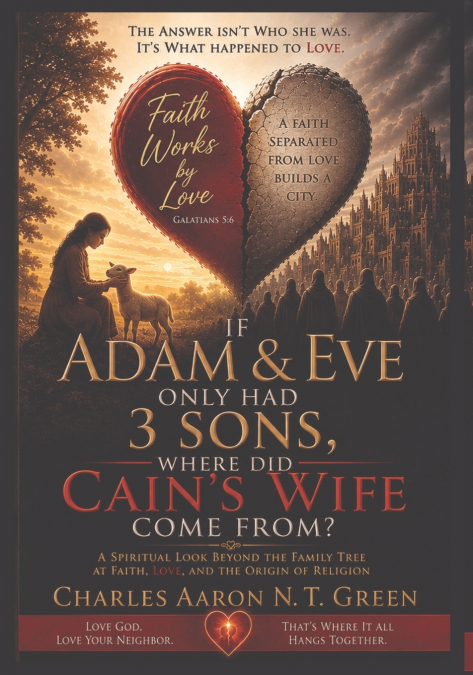
If Adam and Eve only had three named sons, where did Cain’s wife come from?For generations, readers have been given a familiar answer: Cain must have married his sister. But there is one problem-the Bible never actually says that.In If Adam & Eve Only Had 3 Sons, Where Did Cain’s Wife Come From?, Charles Aaron N. T. Green returns to the opening chapters of Genesis and asks readers to reconsider assumptions that have often been treated as Scripture itself.What if Adam represents more than one individual man? Genesis 5:2 says that God created male and female and 'called their name Adam.' Scripture likewise uses the name Jacob to represent not only a man, but an entire people-Israel.What, then, if Cain and Abel also communicate something much greater than the story of two biological brothers?Drawing upon Scripture and a spiritual understanding that parallels important elements of Emanuel Swedenborg’s interpretation of Genesis, Green explores Adam as representative of the Most Ancient Church, the seven days of creation as a picture of spiritual regeneration, Abel as charity or brotherly love, and Cain as faith increasingly separated from that love.From that perspective, one of the Bible’s oldest mysteries takes on an entirely different meaning.Cain’s wife may not be a missing woman at all.She may represent a Church joining itself-or becoming 'married'-to an idea: faith separated from love.And Cain’s city?An idea becomes a belief. A belief becomes a doctrine. A doctrine becomes a system. And eventually, an entire religious structure can be built around it.Written in a plain, conversational and questioning style, this book invites readers to examine the difference between what Scripture actually says and what tradition has taught us to assume.Along the way, Green connects Genesis with Christ’s teaching that the entire law hangs upon loving God and loving our neighbour, Paul’s declaration that 'faith...worketh by love,' and the enduring warning of 1 Corinthians 13: without charity, even extraordinary faith profits us nothing.This is therefore more than a book about Cain’s mysterious wife.It is a book about faith, charity, religion, spiritual decline, regeneration-and love.Because perhaps the most important question was never:'Where did Cain find his wife?'Perhaps the question we should have been asking all along is:'Where did Cain lose his love?'And the answer to Cain, religious legalism, division and hatred may have been before us from the beginning:Love God. Love your neighbour. Faith works by love.The solution-the answer-is, and always will be, love. 6