
I Am You

I Am You

Daniel Kolak

464,05 €
IVA incluido
Disponible
Editorial:
Springer Nature B.V.
Año de edición:
2010
Materia
Ética y filosofía moral
ISBN:
9789048167647
464,05 €
IVA incluido
Disponible

Selecciona una librería:

  • Librería Samer Atenea
  • Librería Aciertas (Toledo)
  • Kálamo Books
  • Librería Perelló (Valencia)
  • Librería Elías (Asturias)
  • Donde los libros
  • Librería Kolima (Madrid)
  • Librería Proteo (Málaga)

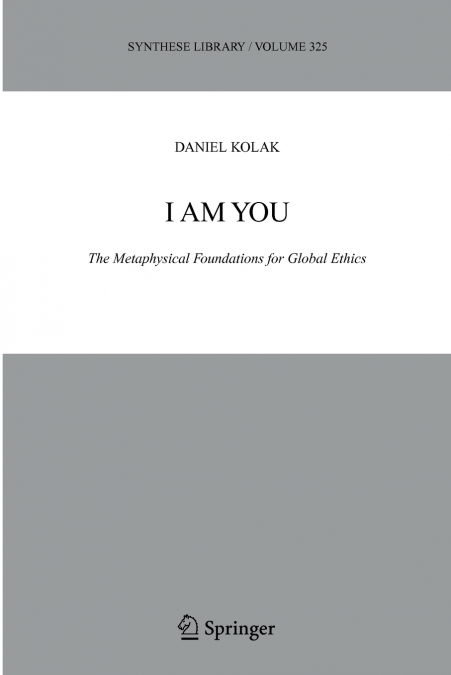
Borders enclose and separate us. We assign to them tremendous significance. Along them we draw supposedly uncrossable boundaries within which we believe our individual identities begin and end, erecting the metaphysical dividing walls that enclose each one of us into numerically identical, numerically distinct, entities: persons. Do the borders between us - physical, psychological, neurological, causal, spatial, temporal, etc. - merit the metaphysical significance ordinarily accorded them? The central thesis of I Am You is that our borders do not signify boundaries between persons. We are all the same person. Variations on this heretical theme have been voiced periodically throughout the ages (the Upanishads, Averroës, Giordano Bruno, Josiah Royce, Schrödinger, Fred Hoyle, Freeman Dyson). In presenting his arguments, the author relies on detailed analyses of recent formal work on personal identity, especially that of Derek Parfit, Sydney Shoemaker, Robert Nozick, David Wiggins, Daniel C. Dennett and Thomas Nagel, while incorporating the views of Descartes, Leibniz, Wittgenstein, Schopenhauer, Kant, Husserl and Brouwer. His development of the implied moral theory is inspired by, and draws on, Rawls, Sidgwick, Kant and again Parfit. The traditional, commonsense view that we are each a separate person numerically identical to ourselves over time, i.e., that personal identity is closed under known individuating and identifying borders - what the author calls Closed Individualism - is shown to be incoherent. The demonstration that personal identity is not closed but open points collectively in one of two new directions: either there are no continuously existing, self-identical persons over time in the sense ordinarily understood - the sort of view developed by philosophers as diverse as Buddha, Hume and most recently Derek Parfit, what the author calls Empty Individualism - or else you are everyone, i.e., personal identity is not closed under known individuating and identifying borders, what the author calls Open Individualism. In making his case, the author: - offers a new explanation both of consciousness and of self-consciousness - constructs a new theory of Self - explains psychopathologies (e.g. multiple personality disorder, schizophrenia) - shows Open Individualism to be the best competing explanation of who we are - provides the metaphysical foundations for global ethics. The book is intended for philosophers and the philosophically inclined - physicists, mathematicians, psychiatrists, psychologists, linguists, computer scientists, economists, and communication theorists. It is accessible to graduate students and advanced undergraduates.

Artículos relacionados

  • Ka Ab Ba Building The Lighted Temple
    Dr Terri R. Nelson / Dr Terri RNelson
    The book KaAbBa Building The Lighted Temple/Metaphysical Keys to the Tree of Life draws a circle that is inclusive of the Afrikan origin of the Ancient Kemetic/Egyptian wisdom. It reveals the undeniable root and link of Ancient Africa to all the religious systems that would develop worldwide. This book is explosive in its power to convey the meaning of KaAbBa, the Medu Neter  (...
    Disponible

    37,41 €

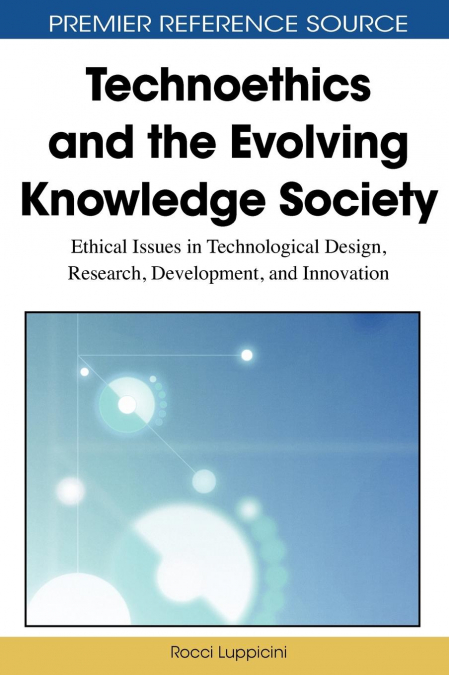
  • Technoethics and the Evolving Knowledge Society
    Rocci Luppicini
    Recently, there has been a major push to rediscover the ethical dimension of technology across the sciences, social sciences, and humanities. Technoethics and the Evolving Knowledge Society: Ethical Issues in Technological Design, Research, Development, and Innovation examines human processes and practices connected to technology embedded within social, political, and moral sph...
    Disponible

    236,22 €

  • Kant
    Immanuel Kant
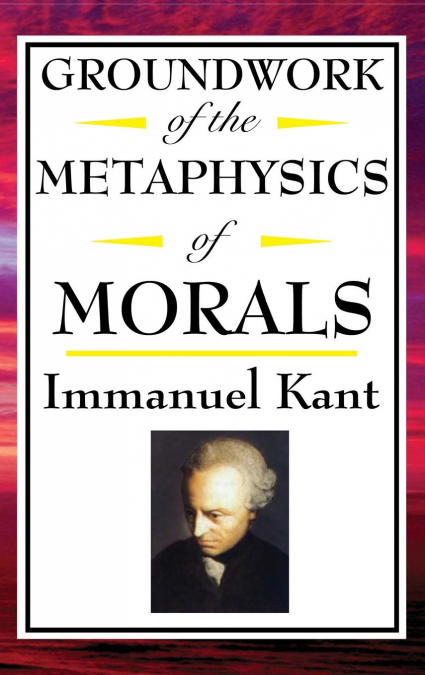
    Kant’s Groundwork of the Metaphysics of Morals is one of the most important works in modern moral philosophy. It belongs beside Plato, Aristotle, Machiavelli, and Hobbes. Here Kant sets out to articulate and defend the Categorical Imperative - the fundamental principle that underlies moral reasoning - and to lay the foundation for a comprehensive account of justice and human vi...
    Disponible

    20,26 €

  • On the Duty of Civil Disobedience
    HENRY DAVID THOREAU
    Civil Disobedience argues that citizens should not permit their governments to overrule their consciences, and that they have a duty to avoid allowing their acquiescence to enable the government to make them the agents of injustice. Thoreau was motivated in part by his disgust with slavery and the Mexican-American War, but the sentiments he expresses here are just as pertinent ...
    Disponible

    17,75 €

  • Beyond Good and Evil
    Friedrich Nietzsche
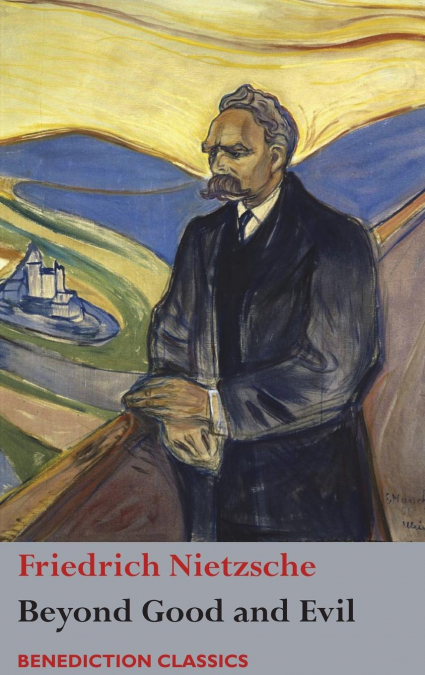
    Nietzsche, though primarily a philosopher, wrote widely on art, philology, history, religion, tragedy, culture, and science.  In 1886, at the height of his powers, he published Beyond Good and Evil.  Here he examines much of the best of human thought--dogmatic philosophy, Judeo-Christian morality, science and democracy – and finds it lacking.  Rejecting “slave-morality” he pres...
    Disponible

    21,70 €

  • Beyond Good and Evil
    Friedrich Nietzsche
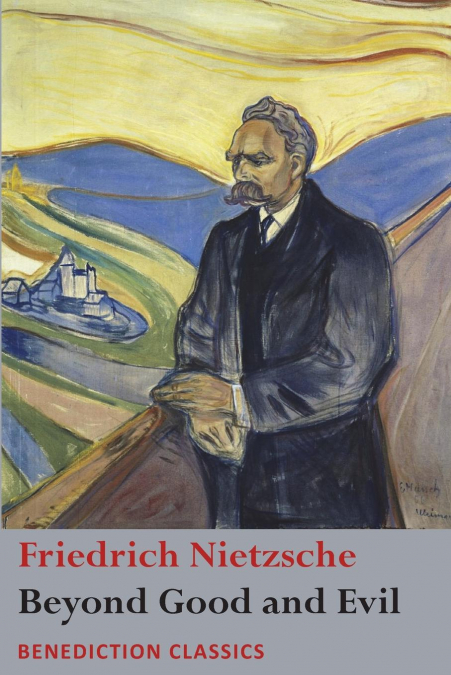
    Nietzsche, though primarily a philosopher, wrote widely on art, philology, history, religion, tragedy, culture, and science.  In 1886, at the height of his powers, he published Beyond Good and Evil.  Here he examines much of the best of human thought--dogmatic philosophy, Judeo-Christian morality, science and democracy – and finds it lacking.  Rejecting “slave-morality” he pres...
    Disponible

    9,99 €

Otros libros del autor

  • I Am You
    Daniel Kolak
    Borders enclose and separate us. We assign to them tremendous significance. Along them we draw supposedly uncrossable boundaries within which we believe our individual identities begin and end, erecting the metaphysical dividing walls that enclose each one of us into numerically identical, numerically distinct, entities: persons. Do the borders betwee...
    Disponible

    401,22 €