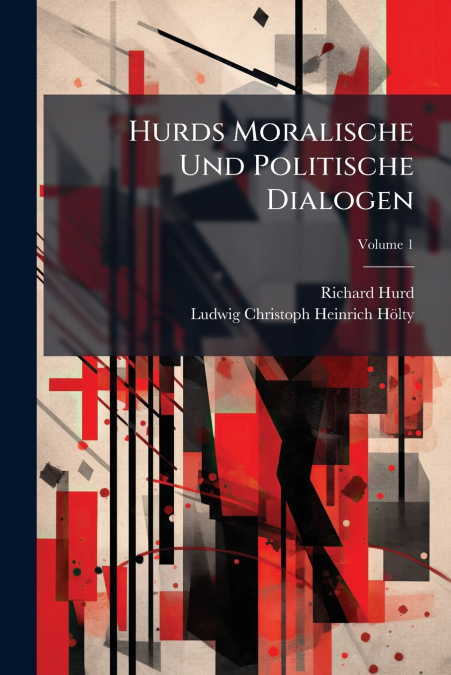
Richard Hurd / Ludwig Christoph Heinrich Hölty
 Librería Samer Atenea
 Kálamo Books
 Librería Elías (Asturias)
 Librería Kolima (Madrid)
 Librería Proteo (Málaga)
Hurd’s Moral and Political Dialogues, Volume 1, presents a series of insightful conversations exploring moral philosophy and political thought. Authored by Richard Hurd with contributions by Ludwig Christoph Heinrich Hölty, this volume delves into a range of ethical and political issues prevalent in the 18th century. Through engaging dialogues, Hurd examines the complexities of human behavior, governance, and the foundations of a just society. Readers will find thought-provoking discussions on topics such as virtue, civic duty, and the principles that underpin effective leadership. This collection offers a valuable glimpse into the intellectual landscape of the Enlightenment era, making it an essential resource for students and scholars of political philosophy and moral thought. This volume continues to offer timeless insights into the enduring questions of ethics and governance.This work has been selected by scholars as being culturally important, and is part of the knowledge base of civilization as we know it. This work was reproduced from the original artifact, and remains as true to the original work as possible. Therefore, you will see the original copyright references, library stamps (as most of these works have been housed in our most important libraries around the world), and other notations in the work.This work is in the public domain in the United States of America, and possibly other nations. Within the United States, you may freely copy and distribute this work, as no entity (individual or corporate) has a copyright on the body of the work.As a reproduction of a historical artifact, this work may contain missing or blurred pages, poor pictures, errant marks, etc. Scholars believe, and we concur, that this work is important enough to be preserved, reproduced, and made generally available to the public. We appreciate your support of the preservation process, and thank you for being an important part of keeping this knowledge alive and relevant.