
Human Nature and Conduct

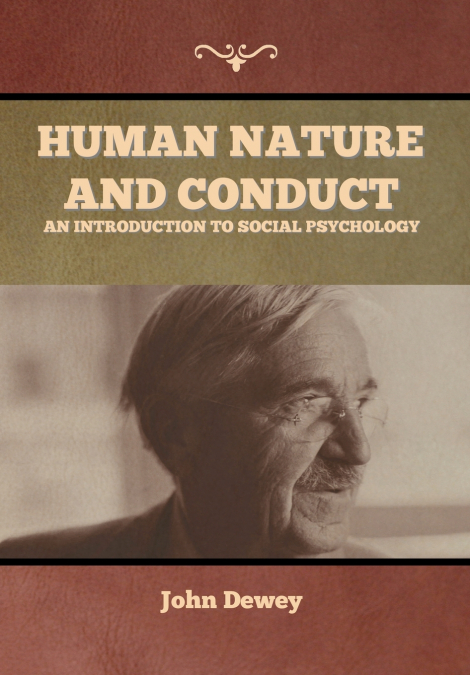
Human Nature and Conduct

John Dewey

29,43 €
IVA incluido
Consulta disponibilidad
Editorial:
Bibliotech Press
Año de edición:
2020
Materia
Psicología
ISBN:
9781647999063

Selecciona una librería:

  • Librería Samer Atenea
  • Librería Aciertas (Toledo)
  • Kálamo Books
  • Librería Perelló (Valencia)
  • Librería Elías (Asturias)
  • Donde los libros
  • Librería Kolima (Madrid)
  • Librería Proteo (Málaga)

John Dewey (October 20, 1859 – June 1, 1952) was an American philosopher, psychologist, and educational reformer whose ideas have been influential in education and social reform. He is regarded as one of the most prominent American scholars in the first half of the twentieth century.The overriding theme of Dewey's works was his profound belief in democracy, be it in politics, education, or communication and journalism. As Dewey himself stated in 1888, while still at the University of Michigan, "Democracy and the one, ultimate, ethical ideal of humanity are to my mind synonymous." Known for his advocacy of democracy, Dewey considered two fundamental elements—schools and civil society—to be major topics needing attention and reconstruction to encourage experimental intelligence and plurality. Dewey asserted that complete democracy was to be obtained not just by extending voting rights but also by ensuring that there exists a fully formed public opinion, accomplished by communication among citizens, experts, and politicians, with the latter being accountable for the policies they adopt.Dewey was one of the primary figures associated with the philosophy of pragmatism and is considered one of the fathers of functional psychology. His paper "The Reflex Arc Concept in Psychology," published in 1896, is regarded as the first major work in the (Chicago) functionalist school. A Review of General Psychology survey, published in 2002, ranked Dewey as the 93rd most cited psychologist of the 20th century.Dewey was also a major educational reformer for the 20th century. A well-known public intellectual, he was a major voice of progressive education and liberalism. While a professor at the University of Chicago, he founded the University of Chicago Laboratory Schools, where he was able to apply and test his progressive ideas on pedagogical method. Although Dewey is known best for his publications about education, he also wrote about many other topics, including epistemology, metaphysics, aesthetics, art, logic, social theory, and ethics. (wikipedia.org) 

Artículos relacionados

  • Drinkers of Infinity
    Arthur Koestler
    This selection of essays, book-reviews, broadcast talks and papers delivered to learned societies reflects the extraordinary breadth of Arthur Koestler’s interests. From the trial of Galileo to the pleasures of canoeing down the Loire, from a detailed examination of the ‘memory’ of flatworms to an equally detailed examination of the futility of quarantining dogs, the author wri...
    Disponible

    17,24 €

  • Gordy the Rabbit has ADHD
    Jessie Shepherd
    Often when people are given a mental health disorder diagnosis the weaknesses are clear and overwhelmingly emphasized, while the strengths are ignored or forgotten. The mental health children's book series 'What Mental Disorder?' challenges the stigma against therapy and diagnosis. It enlists the reader to view the character as a whole being and not as a mental issu...
    Disponible

    16,30 €

  • The Paradoxical Ego
    Eugene Halliday / Zhu Kabere
    Three particular themes are basic to this study. First, that the human race and its environment are involved in a slowly progressive process of revelation and understanding of its inherent features; and that we are all participating in this ongoing evolutionary cycle. Second, and closely related to the first tenet, man is not separable from his environment. We all share in this...
    Disponible

    14,56 €

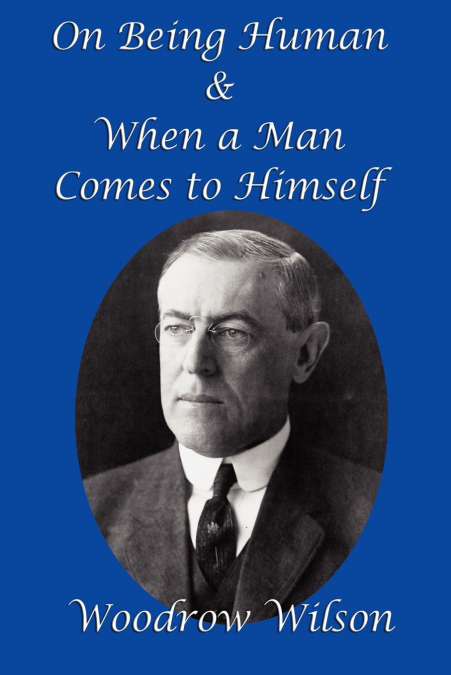
  • On Being Human and When a Man Comes to Himself
    Woodrow Wilson
    Before he became the 28th President of the United States (1913-21), the 34th Governor of New Jersey (1911-13), or even the 13th President of Princeton University (1902-10), Woodrow Wilson (1856-1924) was a scholar and professor. In 1885, he received his Ph.D. in history and political science from Johns Hopkins University, and in 1897, he was granted tenure at Princeton Universi...
    Disponible

    6,28 €

  • Bridge Over The River Why
    David Cooper / Deborah Cooper
    'In Bridge Over the River Why, the Coopers have succeeded in a dual task documenting their own journey through the grief of losing their son Eli by suicide, while at the same time providing a valuable resource for anyone who has had to face the same terrible tragedy. They start with the premise that 'doing and feeling' are the key components of moving forward and have a core me...
  • Extraordinary Leadership
    Cher Holton
    This transformational leadership book, grounded in state-of-the-art research and proven by real-life application in the trenches, moves beyond traditional leadership theories to introduce you to seven incredible Core Abilities and shows you how to connect with them to become an Extraordinary Leader who can bring out the very best in your people.All the techniques in the world w...
    Disponible

    23,85 €

Otros libros del autor

  • Democracy and Education (Esprios Classics)
    John Dewey
    John Dewey (October 20, 1859 - June 1, 1952) was an American philosopher, psychologist, and educational reformer whose ideas have been influential in education and social reform. He was one of the most prominent American scholars in the first half of the twentieth century. The overriding theme of Dewey’s works was his profound belief in democracy, be it in politics, education, ...
  • The Public and Its Problems
    John Dewey
    The Public and Its Problems (1927) by John Dewey is a philosophical and political work examining the nature of democracy in modern society.Dewey argues that a 'public' forms whenever the actions of individuals have indirect consequences for others, creating shared problems that require collective regulation. In modern, complex societies, these consequences are often obscured by...
    Disponible

    14,18 €

  • The Public and Its Problems
    John Dewey
    The Public and Its Problems (1927) by John Dewey is a philosophical and political work examining the nature of democracy in modern society.Dewey argues that a 'public' forms whenever the actions of individuals have indirect consequences for others, creating shared problems that require collective regulation. In modern, complex societies, these consequences are often obscured by...
  • Democracy and Education
    John Dewey
    Democracy and Education (1916) by John Dewey argues that education is the foundation of a healthy democracy. Dewey sees education not as rote learning, but as a social process through which individuals grow by participating in shared experiences. Schools, he claims, should mirror democratic life by encouraging cooperation, critical thinking, and problem-solving rather than pass...
    Disponible

    30,72 €

  • Democracy and Education
    John Dewey
    Democracy and Education (1916) by John Dewey argues that education is the foundation of a healthy democracy. Dewey sees education not as rote learning, but as a social process through which individuals grow by participating in shared experiences. Schools, he claims, should mirror democratic life by encouraging cooperation, critical thinking, and problem-solving rather than pass...
  • Human Nature and Conduct - An introduction to social psychology
    John Dewey
    In the spring of 1918 I was invited by Leland Stanford Junior University to give a series of three lectures upon the West Memorial Foundation. One of the topics included within the scope of the Foundation is Human Conduct and Destiny. This volume is the result, as, according to the terms of the Foundation, the lectures are to be published. The lectures as given have, however, b...
    Disponible

    16,71 €