
Inicio > > Ciencias de la computación > Human Machine Symbiosis
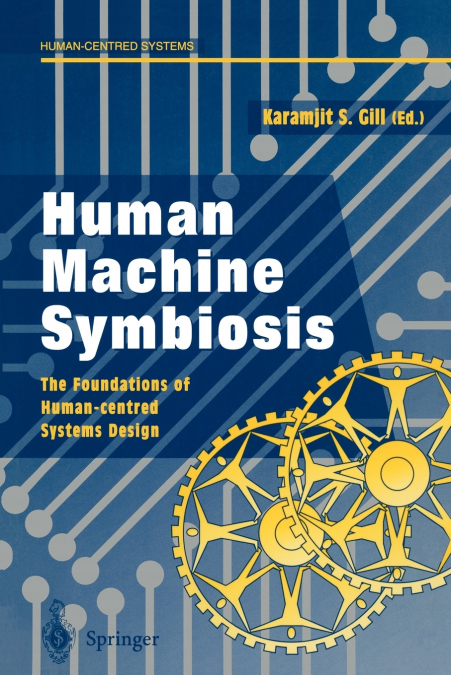
Human Machine Symbiosis

Human Machine Symbiosis

Karamjit S. Gill

132,91 €
IVA incluido
Disponible
Editorial:
Springer Nature B.V.
Año de edición:
1996
Materia
Ciencias de la computación
ISBN:
9783540760245
132,91 €
IVA incluido
Disponible

Selecciona una librería:

  • Librería Samer Atenea
  • Librería Aciertas (Toledo)
  • Kálamo Books
  • Librería Perelló (Valencia)
  • Librería Elías (Asturias)
  • Donde los libros
  • Librería Kolima (Madrid)
  • Librería Proteo (Málaga)

There is now a serious discussion taking place about the moment at which human beings will be surpassed and replaced by the machine. On the one hand we are designing machines which embed more and more human intelligence, but at the same time we are in danger of becoming more and more like machines. In these circumstances, we all need to consider: • What can we do? • What should we do? • What are the alternatives of doing it? This book is about the human-centred alternative of designing systems and technologies. This alternative is rooted in the European tradition of human-centredness which emphasises the symbiosis of human capabilities and machine capacity. The human-centred tra­ dition celebrates the diversity of human skill and ingenuity and provides an alternative to the ’mechanistic’ paradigm of ’one best way’, the ’sameness of science’ and the ’dream of the exact language’. This alternative vision has its origin in the founding European human-centred movements of the 1970s. These include the British movement of Socially Useful Technology, the Scandinavian move­ ment of Democratic Participation, and the German movement of Humanisation of Work and Technology. The present volume brings together various strands of human-centred systems philosophy which span the conceptual richness and cultural diversity of the human-centred movements. The core ideas of human-centredness include human-machine symbiosis, the tacit dimension of knowl­ edge, the system as a tool rather than a machine, dialogue, partici­ pation, social shaping and usability.

Artículos relacionados

  • Skills for Managing Rapidly Changing IT Projects
    Fabrizio Fioravanti
    ...
    Disponible

    118,39 €

  • Design and Usability of Digital Libraries
    Schubert Foo / Yin-Leng Theng
    ...
    Disponible

    112,35 €

  • Intelligent Information Technologies and Applications
    Vijayan Sugumaran
    ...
    Disponible

    131,73 €

  • Mobile Technology Consumption
    Whether used for communication, entertainment, socio-economic growth, crowd-sourcing social and political events, monitoring vital signs in patients, helping to drive vehicles, or delivering education, mobile technology has been transformed from a mode to a medium. Mobile Technology Consumption: Opportunities and Challenges explores essential questions related to the cost, bene...
    Disponible

    249,07 €

  • Creating Personal, Social, and Urban Awareness through Pervasive Computing
    Guo
    The recent emergence and prevalence of social network applications, sensor equipped mobile devices, and the availability of large amounts of geo-referenced data have enabled the analysis of new context dimensions that involve individual, social, and urban context. Creating Personal, Social, and Urban Awareness through Pervasive Computing provides an overview of the theories, te...
    Disponible

    230,09 €

  • Fostering 21st Century Digital Literacy and Technical Competency
    Antonio Cartelli
    The 21st century has seen an expansion in digital technology and the ways in which it affects everyday life. These technologies have become essential in the growth of social communication and mass media. Fostering 21st Century Digital Literacy and Technical Competency offers the latest in research on the technological advances on computer proficiency in the educational system a...
    Disponible

    229,67 €

Otros libros del autor

  • Information Society
    Karamjit S. Gill
    Human-centredness: A Challenge to Post-industrial Europe? The key power in industrial society has been linked to the possession of capital and factory. In the 'information society' it could be rather different. If one accepts that that the key power in the information society will be linked not so much to the ownership of information but to human crea...
    Disponible

    133,29 €