
How We Think

How We Think

How We Think

John Dewey

31,30 €
IVA incluido
Disponible
Editorial:
Kessinger Publishing
Año de edición:
2004
Materia
Filosofía
ISBN:
9781417912049
31,30 €
IVA incluido
Disponible

Selecciona una librería:

  • Librería Samer Atenea
  • Librería Aciertas (Toledo)
  • Kálamo Books
  • Librería Perelló (Valencia)
  • Librería Elías (Asturias)
  • Donde los libros
  • Librería Kolima (Madrid)
  • Librería Proteo (Málaga)

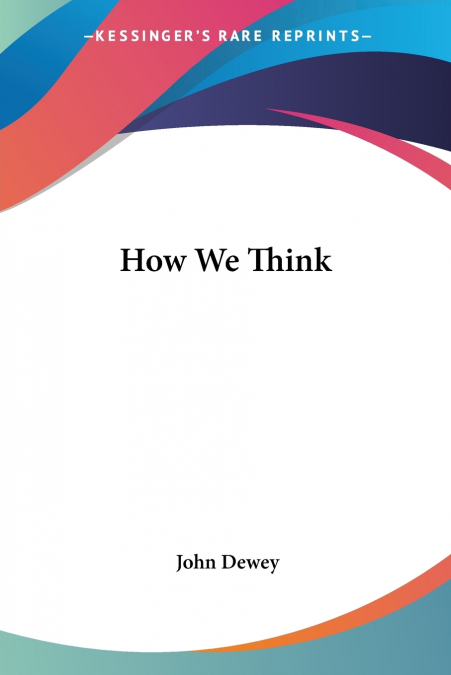
How We Think is a classic book written by American philosopher and educator John Dewey. In this book, Dewey explores the nature of thinking and how it relates to education, problem-solving, and everyday life. He argues that thinking is not a passive process, but an active and dynamic one that involves experimentation, reflection, and creativity. Dewey also emphasizes the importance of context and experience in shaping our thinking processes, and how we can use these insights to improve our thinking skills and become more effective learners and problem-solvers. The book is written in a clear and accessible style, making it an essential read for anyone interested in the nature of thinking and its role in education and personal development.1910. Dewey, Professor of Philosophy in Columbia University writes: Our schools are troubled with a multiplication of studies, each in turn having its own multiplication of materials and principles. Our teachers find their tasks made heavier in that they have come to deal with pupils individually and not merely in mass. Unless these steps in advance are to end in distraction, some clue of unity, some principle that makes for simplification must be found. This book represents the conviction that the needed steadying and centralizing factor is found in adopting as the end of endeavor that attitude of mind, that habit of thought, which we call scientific. This scientific attitude of mind might, conceivably, be quite irrelevant to teaching children and youth. But this book also represents the conviction that such is not the case; that the native and unspoiled attitude of childhood, marked by ardent curiosity, fertile imagination, and love of experimental inquiry is near, very near, to the attitude of the scientific mind. See other titles by this author available from Kessinger Publishing.This scarce antiquarian book is a facsimile reprint of the old original and may contain some imperfections such as library marks and notations. Because we believe this work is culturally important, we have made it available as part of our commitment for protecting, preserving, and promoting the world’s literature in affordable, high quality, modern editions, that are true to their original work.

Artículos relacionados

  • Introduction to a Future Way of Thought
    Kostas Axelos / Kenneth Mills
    'Technologists only change the world in various ways in generalized indifference; the point is to think the world and interpret the changes in its unfathomability, to perceive and experience the difference binding being to the nothing.'Anticipating the age of planetary technology Kostas Axelos, a Greek-French philosopher, approaches the technological question in this book, firs...
    Disponible

    18,58 €

  • Capsule
    John Kenneth Press
    Join John and Adam as they wander the mean streets of Japan on a psychedelic fueled search for identity. While fun for the average reader, this book could also serve as a philosphy textbook because of its ordered exploration of sources of identity. Ultimately this trip through nationalist attacks, sex, and drugs, will take you to a better understanding of yourself and your pl...
    Disponible

    11,51 €

  • If you look at it long enough...
    Paul Hallam
    Originally written for an academic journal, If you look at it long enough... is primarily a personal account of Paul Hallam’s recollections of “self-abuse” through the consumption of porn over several decades. Challenging the familiar form of an “academic essay,” this autobiographical narrative raises several questions in relation to our contemporary morals related to sex in ge...
    Disponible

    11,30 €

  • The Teachers of Gurdjieff
    Rafael Lafort / Rafael Lefort
    When The Teachers of Gurdjieff was first published more than 50 years ago, it made a considerable stir. George Ivanovich Gurdjieff had been one of the most famous mystics in the West in the first half of the 20th century - a teaching master who had many fashionable and influential pupils. He had a striking appearance and manner of teaching, and his teaching proved to be very in...
    Disponible

    20,45 €

  • Manifesto of the Communist Party
    Karl Marx
    The Communist Manifesto was first published on February 21, and it is one of the world’s most influential political tracts. Commissioned by the Communist League and written by communist theorists Karl Marx and Friedrich Engels, it laid out the League’s purposes and program. The Manifesto suggested a course of action for a proletarian (working class) revolution to overthrow the ...
  • The Art of Literature
    Arthur Schopenhauer
    Collected here are eight short essays, On Authorship, On Style, On the Study of Latin, On Men of Learning, On Thinking for Ones Self, On Criticism, On Reputation, On Genius, by the world renowned philosopher Arthur Achopenhauer. ...

Otros libros del autor

  • Democracy and Education (Esprios Classics)
    John Dewey
    John Dewey (October 20, 1859 - June 1, 1952) was an American philosopher, psychologist, and educational reformer whose ideas have been influential in education and social reform. He was one of the most prominent American scholars in the first half of the twentieth century. The overriding theme of Dewey’s works was his profound belief in democracy, be it in politics, education, ...
  • The Public and Its Problems
    John Dewey
    The Public and Its Problems (1927) by John Dewey is a philosophical and political work examining the nature of democracy in modern society.Dewey argues that a 'public' forms whenever the actions of individuals have indirect consequences for others, creating shared problems that require collective regulation. In modern, complex societies, these consequences are often obscured by...
    Disponible

    14,18 €

  • The Public and Its Problems
    John Dewey
    The Public and Its Problems (1927) by John Dewey is a philosophical and political work examining the nature of democracy in modern society.Dewey argues that a 'public' forms whenever the actions of individuals have indirect consequences for others, creating shared problems that require collective regulation. In modern, complex societies, these consequences are often obscured by...
  • Democracy and Education
    John Dewey
    Democracy and Education (1916) by John Dewey argues that education is the foundation of a healthy democracy. Dewey sees education not as rote learning, but as a social process through which individuals grow by participating in shared experiences. Schools, he claims, should mirror democratic life by encouraging cooperation, critical thinking, and problem-solving rather than pass...
    Disponible

    30,72 €

  • Democracy and Education
    John Dewey
    Democracy and Education (1916) by John Dewey argues that education is the foundation of a healthy democracy. Dewey sees education not as rote learning, but as a social process through which individuals grow by participating in shared experiences. Schools, he claims, should mirror democratic life by encouraging cooperation, critical thinking, and problem-solving rather than pass...
  • Human Nature and Conduct - An introduction to social psychology
    John Dewey
    In the spring of 1918 I was invited by Leland Stanford Junior University to give a series of three lectures upon the West Memorial Foundation. One of the topics included within the scope of the Foundation is Human Conduct and Destiny. This volume is the result, as, according to the terms of the Foundation, the lectures are to be published. The lectures as given have, however, b...
    Disponible

    16,71 €