

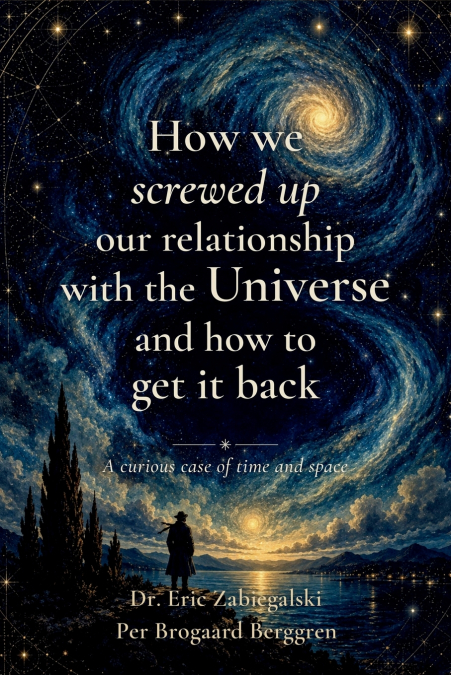
Eric Zabiegalski / Per Brogaard Berggren
 Librería Samer Atenea
 Kálamo Books
 Librería Elías (Asturias)
 Librería Kolima (Madrid)
 Librería Proteo (Málaga)
How We Screwed Up Our Relationship with the Universe, and How to Get It Back explores how humanity became estranged from the living world by mistaking its constructed measurements, models, and abstractions for reality itself. Bringing philosophy into conversation with science, psychology, physiology, organizational theory, artificial intelligence, music, personal experience, and nature, the authors ask whether reality is best understood as collections of separate things or an unfolding field of connected processes and relationships. The book doesn’t argue that things like measurement, analysis, structure, or technology should be abandoned. Instead, it proposes that they should be reunited with lived experience, context, imagination, uncertainty, care, and most of all participation.Four interconnected arguments weave through the book:Time has several legitimate interpretations: physically measured time and lived experience. They cannot be reduced to a single explanatory model to execute its passing; they complement one another.Reality is relational. People, organizations, technologies, and natural systems don’t exist or develop independently. They emerge through processes of interaction, interpretation, adaptation, and co-creation. The truest objectivity is 'intersubjectivity.'Analysis and structure are necessary but incomplete. They allow people and institutions to reduce complexity and coordinate action, but when separated from embodied context, intuition, and ethical responsibility, they produce fragmentation, rigidity, and harm.Technology amplifies the values and habits that surround it. Artificial intelligence will not determine if humanity becomes wiser, more creative, or more alienated. Its effects depend on what designers and users reward, delegate, preserve, practice, include, and leave out.Humanity has constructed a representation of reality and gradually started treating the representation (model) as reality itself. We have divided the unfolding world, witnessed separate objects, subjects, resources, disciplines, organizations, identities, and problems, and then attempted to manage the parts while overlooking the relationships through which those parts exist and acquire their meaning. We have separated and isolated the meaningful things that emerge from the relationships and then wondered why they lost their meaning. The book ultimately argues that restoring our relationship with the universe doesn’t require rejecting clocks, science, rationality, technology, or agency. It requires placing them back into a reverent contrasting relationship with lived experience, context, embodiment, intuition, uncertainty, other people and forms of life, and the larger processes from which we, and everything, emerge.Part philosophical inquiry, part cultural critique, and part personal exploration, How We Screwed Up Our Relationship with the Universe and How to Get It Back invites the reader to slow down, question representations of reality, and reconsider how they participate in life. Its central proposition is both unsettling and hopeful: humanity created the conditions of its estrangement; humanity can repair them.The book includes two forewords. The first is by Ole Fogh Kirkeby, a prominent Danish philosopher, management theorist, and author. The second is by Dennis Pitocco, who spent three decades in the high-stakes world of global finance before founding 360° Nation, a global media platform.





