
How Wars End

How Wars End

Naim Tahir Baig

70,45 €
IVA incluido
Disponible
Editorial:
Institute of Geo-Strategic Studies
Año de edición:
2026
Materia
Relaciones internacionales
ISBN:
9798235569133
70,45 €
IVA incluido
Disponible

Selecciona una librería:

  • Librería Samer Atenea

  • Kálamo Books
  • Librería Elías (Asturias)
  • Librería Kolima (Madrid)
  • Librería Proteo (Málaga)

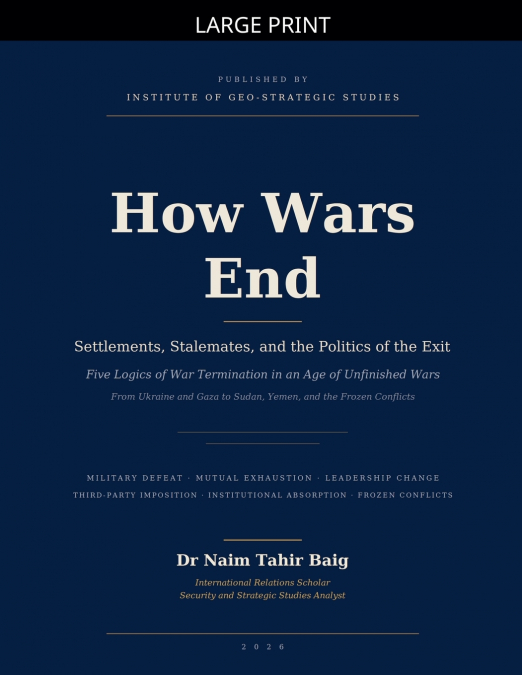
How Wars EndSettlements, Stalemates, and the Politics of the ExitDr Naim Tahir Baig,About the BookIn the spring of 2026, the world confronts a constellation of unended wars unlike any since 1945. Ukraine has entered its fifth year of fighting. The Gaza ceasefire negotiated under American auspices in October 2025 has decayed into a violent middle condition that the existing vocabulary of conflict cannot precisely name. Sudan, partitioned between rival governments in Khartoum and Nyala, has crossed a thousand days of war and produced what the United Nations describes as the world’s worst humanitarian catastrophe. A war between the United States, Israel, and Iran - launched on February 28, 2026 with the killing of Iran’s supreme leader - has closed the Strait of Hormuz and reordered the geopolitics of the Gulf. Myanmar’s military junta has consolidated power through elections the world’s democratic monitors have uniformly rejected. And across this landscape of active wars sit the frozen ones - Korea, Cyprus, Kashmir, Transnistria, Taiwan, Western Sahara - some stable for half a century, others approaching the thaw that turns frozen conflicts into hot ones again.How Wars End offers a framework for understanding this moment and the wars that have produced it. Its central claim is that every war whose ending can be analytically characterized in terms of political closure has done so through one, or some combination, of five mechanisms: military defeat, mutual exhaustion, leadership change, third-party imposition, and institutional absorption. Drawing on a literature stretching from Fred Iklé’s foundational Every War Must End (1971) through I. William Zartman’s ripeness theory, Hein Goemans’s analysis of leadership exposure, and the most recent work on coalitional politics, mediation, and the political economy of conflict, the book builds an integrated framework that is then tested against the live wars of the mid-2020s and against a comparative dataset of historical terminations from Carthage to the present.The argument advances in three parts. The first develops the theory, beginning with the long-standing asymmetry between the rich literature on how wars begin and the comparatively thin library on how they end. It then introduces the five-logic framework, treats each logic at chapter length, theorizes the cross-cutting role of leadership insulation in conflicts driven by war economies, and identifies how the five logics must be modified for asymmetric conflicts in which one party is a non-state actor. The second part applies the framework to live cases - Ukraine, Gaza and the Israel-Iran axis, Sudan, Yemen, Myanmar, and the world’s principal frozen conflicts - using a diagnostic table that the book introduces and applies consistently. The third part draws the prescriptive conclusions: what states, mediators, and informed publics would do differently if they took termination as seriously as initiation.For scholars of international relations and conflict studies, How Wars End offers the most ambitious integration of the termination literature since Reiter’s How Wars End (2009), updated for a world that the existing scholarship was not designed to explain. For diplomats and mediators, it provides a diagnostic instrument - Appendix A’s comparative termination table - that can be applied to any unended war to identify which logic is closest to operative, which preconditions are absent, and what would have to change.
Artículos relacionados

  • Realism in Practice
    The purpose of this book is to appraise the current relevance and validity of realism as an interpretative tool in contemporary International Relations. All chapters of the book are animated by a theoretical effort to define the conceptual aspects of realism and attempt to establish whether the tradition still provides the necessary conceptual tools to scholars.The chapters add...
    Disponible

    20,36 €

  • Predicting gender violence in India
    Shritha K Vasudevan
    In this provocative new book, Shritha Vasudevan argues that feminist international relations (IR) theory has inadvertently resulted in a biased worldview, the very opposite of what feminist IR set out to try to rectify. This book contests theoretical presumptions of Western feminist IR and attempts to reformulate it in contexts of non-Western cultures. Vasudevan deftly utilizes...
  • Contemporary security issues in Africa
    Isiaka Alani Badmus / Lere Amusan
    In volume, an emerging generation of African scholars examines specific states in Africa where instability is the order of the day. Considerations of African instability are highly relevant in today’s world, where one examines the types of regimes that were put in place after the Cold War and their effects on Africa. Multiparty systems introduced in Africa, rather than bringing...
  • Chronicles of the first and second chechen wars
    Ilya Milyukov
    Presented by Russian author and attorney Ilya Milyukov, Chronicles of the First and Second Chechen War presents the main events of the First (1994-1996) and Second (1999-2009) Wars in Chechnya, Russia’s deadliest conflicts since World War II. The First War began in December 1994 and lasted for one year and nine months, ending in August 1996. There were two major urban battles -...
  • Political instability in Africa
    Isiaka Alani Badmus / Lere Amusan
    This book offers broad-gauged analyses of the causes, nature, and changing patterns of armed conflict in Africa as well as the reasons for these patterns. It also situates conflicts that have been haunting the African continent since the time of decolonization within the various theoretical schools such as 'new war,' 'economic war,' 'neo-patrimonial,' and 'globalization.' It be...
  • Subjugate or exterminate!
    Akhmed Zakaev / Arch Tait
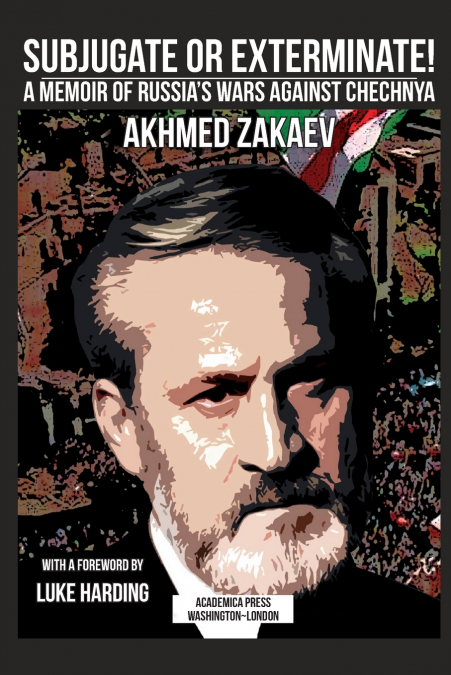
    Foreword by Luke HardingAkhmed Zakaev is a symbol of the indomitable will of the Chechen nation. In this important memoir, he tells the story of the Chechen struggle as he experienced it, describing the conflict in human terms and providing a detailed documentary record of little known or badly understood events that will be of benefit to historians for generations to come.- Da...
    Disponible

    41,63 €

Otros libros del autor

  • The Orbit After Ambiguity
    Naim Tahir Baig
    SPACE SECURITY & ARMS CONTROLThe Orbit After AmbiguityHow the US Admitted It Has Weapons in SpaceThe first narrative account of what changed when the United States stopped keeping its space weapons secret.On September 14, 2026, the Secretary of the Air Force told a Washington audience that the United States 'has on-orbit space control weapons capable of defending the joint forc...
    Disponible

    73,95 €

  • The Stilwell Bypass
    Naim Tahir Baig
    In 1942 the United States Army pushed a road out of Ledo, in Assam, toward China. More than eighty years later, a question hangs over the same ground: could a different cargo travel part of that route, heavy rare earths dug from the clay hills of Kachin State in northern Myanmar and carried not east into China, as they are now, but west, toward India and toward separation plant...
    Disponible

    74,68 €

  • Extinction by Extraction?
    Naim Tahir Baig
    What we choose when we choose our mineralsEvery wind turbine, electric vehicle, guided missile and smartphone depends on a group of metals most people have never heard of. Rare earth elements make the modern world’s energy, defense and computing systems possible. They also come from some of the most toxic, concentrated and politically contested supply chains on Earth.Extinction...
    Disponible

    73,62 €

  • Theory in the Interregnum
    Naim Tahir Baig
    Theory in the InterregnumWhich International Relations Theory Explains What in a World of Fraying RulesBy Naim Tahir BaigThe liberal international order is fraying, and every school of International Relations claims to have seen it coming. Theory in the Interregnum asks a sharper question: which theory explains what? Dr Naim Tahir Baig argues that no new grand theory has displa...
    Disponible

    70,52 €

  • Rules of the Strong, Rules of the Many
    Naim Tahir Baig
    Rules of the Strong, Rules of the ManyAuthorship, Membership and the Ratchet of International Norms from Antiquity to the PresentBy Dr Naim Tahir BaigWho writes the rules of international order, and who do those rules protect? Rules of the Strong, Rules of the Many argues that international norms move in two rhythms at once. Authorship, meaning who writes and interprets the rul...
    Disponible

    75,59 €

  • Custody
    Naim Tahir Baig
    CustodyHow States Compete to Govern the Making of PersonsBy Dr Naim Tahir Baig States everywhere are claiming a new kind of authority: the right to act as guardian over how their citizens are formed. A South Korean subsidy to raise the birth rate, an Australian ban on social media for under-16s, a Brazilian court order against a platform and a Chinese rule for generative AI loo...
    Disponible

    75,54 €