
Inicio > Humanidades > Historia > How Roosevelt Failed America in World War II
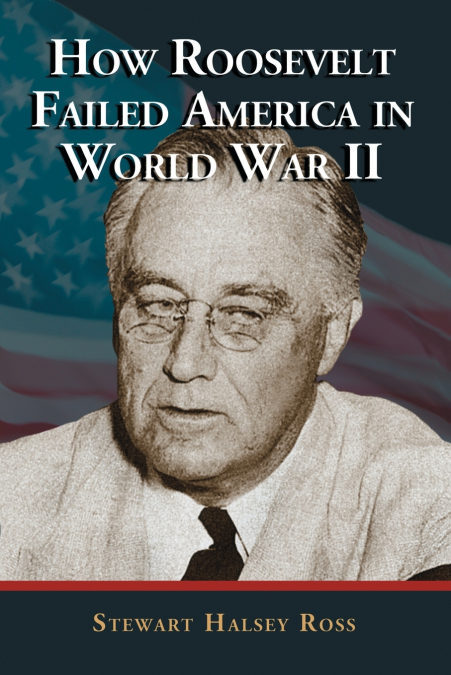
How Roosevelt Failed America in World War II

How Roosevelt Failed America in World War II

Stewart Halsey Ross

57,34 €
IVA incluido
Disponible
Editorial:
McFarland and Company, Inc.
Año de edición:
2006
Materia
Historia
ISBN:
9780786425129
57,34 €
IVA incluido
Disponible

Selecciona una librería:

  • Librería Samer Atenea
  • Librería Aciertas (Toledo)
  • Kálamo Books
  • Librería Perelló (Valencia)
  • Librería Elías (Asturias)
  • Donde los libros
  • Librería Kolima (Madrid)
  • Librería Proteo (Málaga)

Reeling from the devastation of World War I, many Americans vowed never again to become involved in European conflicts. This stance was formalized in 1935 when Congress passed the first Neutrality Act, which was not only designed to keep America out of foreign wars but also called for the president to declare an immediate embargo of arms and munitions to all belligerent countries. As war loomed and eventually erupted in 1939, President Franklin D. Roosevelt instituted several policies that aided the Allies, and American neutrality was questionable many months before the attack on Pearl Harbor. This work examines how Roosevelt navigated prewar neutrality to push the United States toward intervention on the side of the Allies in World War II, and considers critically his wartime policy of unconditional surrender and his unprecedented acceptance of a fourth term. It covers his prewar policies that sidestepped neutrality, including covert submarine warfare, air patrol of the North Atlantic, the Lend Lease Act and coordination between the American and British navies, and critiques his plans for rebuilding postwar Europe. Thirteen appendices parallel prewar planning by Roosevelt and Woodrow Wilson, and reproduce such key documents as the Atlantic Charter and the Potsdam Declaration.

Artículos relacionados

  • Raising Freedom's Banner
    Paul Harris
    World wide history of peaceful street demonstrations from their earliest beginning in eighteenth century England to their use throughout the world in the twenty-first century. Describes why some demonstration movements succeeded and others failed. Contrasts demonstrations within the law with civil disobedience demonstrations. Describes Peterloo, the Chartists, the Suffragettes,...
    Disponible

    23,59 €

  • Waipi’o Valley
    Jeffrey L. Gross
    Waipi’o Valley: A Polynesian Journey from Eden to Eden recounts the remarkable migrations of the Polynesians across a third of the circumference of the earth. Their amazing journey began from Kalana i Hau’ola, the biblical “Garden of Eden” located along the shore of the Persian Gulf, extended to the Indus River Valley of ancient Vedic India, to Egypt where some ancestors of the...
  • Floralia
    June Rainsford Butler
    A century characterized by a growing interest in science, the opportunity for travel, and leisure for gardening furnishes the setting for Butler’s book. The rise of landscape gardening in England is traced, and the origin and history of its most famous gardens are given. The close relation between England and America in the field of horticulture is also discussed.Originally pub...
    Disponible

    61,20 €

  • President Wilson’s Addresses
    Woodrow Wilson
    'These addresses of President Woodrow Wilson are almost entirely concerned with political affairs, and more specifically with defining Americanism. Yet they also show that even as he moved from academia to the heights of politics, Wilson retained something of the teacher’s interest in showing the relation between specific instances and the general forms of thought or action of ...
  • The Story of my Life
    John Albert Macy
    The Story of My Life, is Helen Keller’s autobiography detailing her early life, especially her experiences with Anne Sullivan. The book is dedicated to inventor Alexander Graham Bell. The dedication reads, 'To ALEXANDER GRAHAM BELL Who has taught the deaf to speak and enabled the listening ear to hear speech from the Atlantic to the Rockies, I dedicate this Story of My Life.' ...
  • The Story of My Life Vol. 6 Spanish Passions
    Giacomo Casanova
    Casanova was an Italian adventurer and author from the Republic of Venice. His autobiography, Histoire de ma vie (Story of My Life), is regarded as one of the most authentic sources of the customs and norms of European social life during the 18th century. He has become so famous for his often complicated and elaborate affairs with women that his name is now synonymous with 'wom...

Otros libros del autor

  • Global Predator
    Stewart Halsey Ross
    Global Predator is a damning account of the atrocities committed by invading US armed forces, from the 1846 war on Mexico to the recent wars on Iraq. In between are chapters on the Spanish and Philippines War, the World Wars, Korea, and Vietnam, plus appendices on other incursions. As he marshals the facts for a contrarian view of US history, author Stewart Halsey Ross is anger...
    Disponible

    34,79 €

  • Propaganda for War
    Stewart Halsey Ross
    'THE VERDICT OF THE VERSAILLES TREATY that Germany and her allies were responsible for the War, in view of the evidence now available, is historically unsound. It should therefore be revised.' These are the words of Sidney Bradshaw Fay, noted revisionist historian, on the concluding page of his magisterial Origins of the World War, published in 1928. We now know more about the ...
    Disponible

    21,89 €

  • Strategic Bombing by the United States in World War II
    Stewart Halsey Ross
    The United States relied heavily on bombing to defeat the Germans and the Japanese in World War II, and air raids were touted as 'precision' bombing in American propaganda. But was precision possible over cloud-covered Europe or a darkened Japanese countryside? Could the vaunted Norden optical bombsight in fact 'drop bombs into pickle barrels' as advertised? Were the America...
    Disponible

    42,73 €

  • The Management of Business-To-Business Advertising
    Stewart Halsey Ross
    ...