
Inicio > Derecho > Derecho internacional > How International Law Works in Times of Crisis
How International Law Works in Times of Crisis

How International Law Works in Times of Crisis


219,08 €
IVA incluido
Consulta disponibilidad
Editorial:
Oxford University Press
Año de edición:
2019
Materia
Derecho internacional
ISBN:
9780198849667

Selecciona una librería:

  • Librería Samer Atenea
  • Librería Aciertas (Toledo)
  • Kálamo Books
  • Librería Perelló (Valencia)
  • Librería Elías (Asturias)
  • Donde los libros
  • Librería Kolima (Madrid)
  • Librería Proteo (Málaga)

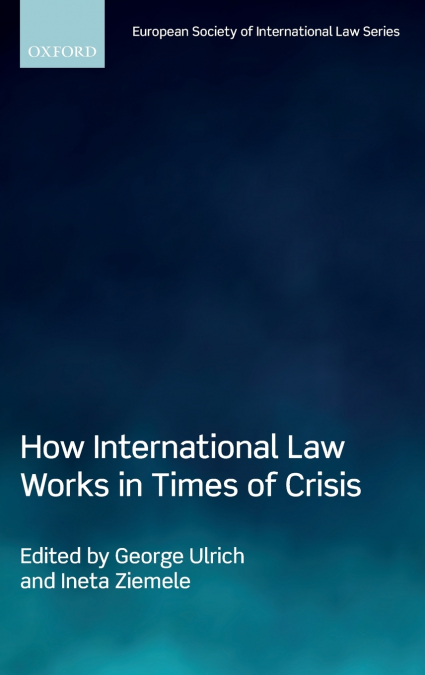
For some time, the word ’crisis’ has been dominating international political discourse. But this is nothing new. Crisis has always been part of the discipline of international law. History indeed shows that international law has developed through reacting to previous experiences of crisis, reflecting an agreement on what it takes to avoid their repetition. However, human society evolves and challenges existing rules, structures, and agreements. International law is confronted with questions as to the suitability of the existing legal framework for new stages of development. Ulrich and Ziemele here bring together an expert group of scholars to address the question of how international law confronts crises today in terms of legal thought, rule-making, and rule-application. The editors have characterized international law and crisis discourse as one of a dialectical nature, and have grouped the articles contained in the volume under four main themes: security, immunities, sustainable development, and philosophical perspectives. Each theme pertains to an area of international law which at the present moment in time is subject to notable challenges and confrontations from developments in human society. The surprising general conclusion which emerges is that, by and large, the international legal system contains concepts, principles, rules, mechanisms and formats for addressing the various developments that may prima facie seem to challenge these very same elements of the system. Their use, however, requires informed policy decisions.
Artículos relacionados

  • Comparative regulation, economic analysis, and applications of private equity in the united states and european union
    Irini Liakopoulou
    The present work examines the economics and legal doctrine of private equity. After a consideration of private equity’s origins, the book will explore the evolution of private equity in the United States and Europe. The reference economic model then will be reconstructed, with particular attention to financial flows to and from private equity firms and funds. This reconstructio...
  • Complicity in International Law
    Dimitris Liakopoulous
    Complicity in International Law aims to analyze questions arising from a state’s complicity in conflict with another state or an international organization. On the basis of international legal provisions, a state that assists the illicit fact of another state or an international organization in turn commits an offense if it is aware of the main fact and is bound by the same obl...
  • Command responsibility
    James B Whisker / Kevin R Spiker
    Command responsibility, or executive accountability, assumes that leaders are responsible for the actions of their subordinates. If subordinates misbehave, violate basic moral laws, transgress international law, or thwart international standards of behavior, their leader may be called before to justice. Standards that set the boundaries of human action have been evolving for ma...
  • International Organizations and Reparations
    Dimitris Liakopoulos
    In the first part of this book, noted legal scholar Dimtris Liakopoulos deals with reconstructing the legal regulatory framework governing human rights violations in the activities of organizations. After identifying rules that are generally applicable to organizations’ offenses and govern the profile of reparations, this study assesses primary rules that guarantee the right to...
  • International Organizations and Legal Sanctions Against Governments
    Dimitris Liakopoulos
    This book examines the relationship between governments and international organizations under international law. After surveying the policing powers of international organizations under international law, it illustrates some normative aspects of law that distinguish regulation from enforcement via study of recent legal cases before international judicial bodies. According to Di...
  • The EU Foreign Subsidies Regulation
    Andreas Reindl / Isabelle Van Damme
    'The EU Foreign Subsidies Regulation' is a pioneering manual authored by legal experts Andreas Reindl and Isabelle Van Damme. This essential guide, the first of its kind, is tailored for legal practitioners, offering a thorough exploration of the tools and mechanisms embedded within this novel European regulatory framework. The authors meticulously dissect the EU Foreign Subsid...