 Librería Samer Atenea
 Kálamo Books
 Librería Elías (Asturias)
 Librería Kolima (Madrid)
 Librería Proteo (Málaga)
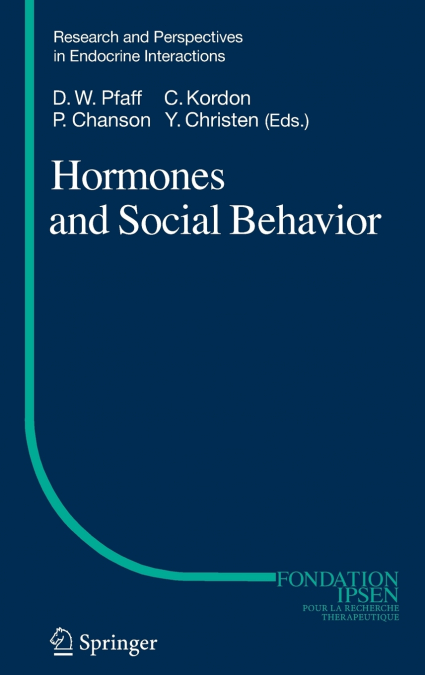
SocialBonding,aProductofEvolution: anIntroductiontotheVolume Mechanisms underlying reproductive and maternal functions or coping represent the initialstructuringforcebehindmanysocialbehaviors.Theyareaccompaniedbysel- tivehormonalenvironmentsaimedatfacilitatingor stabilizingthem.Sexandadrenal steroids are major players in the regulation of reproductive functions and coping challenges, but other hormones also participate in a variety of social behaviors (in particular,oxytocinandvasopressin,twophylogeneticallyveryoldmoietiesoriginally associated with maternal care and water balance) and are receiving increasing att- tion. Their role is highlighted in the present volume, which gathers contributions to theColloqueMédicineetRecherche'HormonesandSocialBehavior'organizedbythe FondationIPSENinDecember 2007. Whatisthekeytounderstandingtherationaleofhormonalsubstratesofbehavior? Evolution, of course. Higher manifestations of social behavior have evolved from - productivebehavior,characterizedbyErnstMayras'theleadingedgeofevolutionary change.' As formulated by one contributor to thisvolume, however, 'the evolutionary increase in neocortex seen in primates has induced a signi?cant emancipation of - havior from hormonal determinants, and in parallel, an increasing role for intelligent socialstrategies'(Keverne 2008). In so-called 'lower' mammalian animals, many social behaviors are closely - pendent upon the olfactory system, a component of autonomous regulation of such importancethatitexpressesalargeproportionofallreceptorgenespresentinthebrain. Whenonelooksat'higher'mammalssuchasprimates,olfactorycontrolbecomesless stringent. Olfactory structures exhibit the same number of receptor genes, but a large number are transformed into non-coding 'pseudogenes.' In parallel, hormones i- tially targeted on physiological functions become increasingly associated with more diversi?edcognitivefunctions.