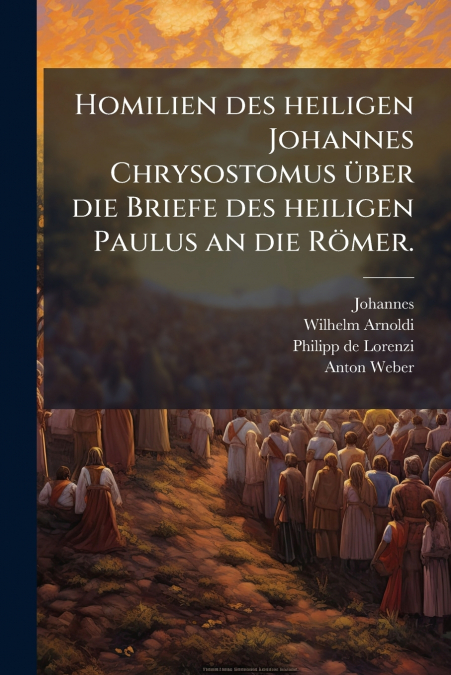
Johannes (Chrysostomus) / Wilhelm Arnoldi / Philipp de Lorenzi
 Librería Samer Atenea
 Kálamo Books
 Librería Elías (Asturias)
 Librería Kolima (Madrid)
 Librería Proteo (Málaga)
Die 'Homilien des heiligen Johannes Chrysostomus über die Briefe des heiligen Paulus an die Römer', übersetzt und herausgegeben von Wilhelm Arnoldi, Philipp de Lorenzi und Anton Weber, bieten eine umfassende Auslegung der Paulusbriefe. Johannes Chrysostomus, einer der bedeutendsten Kirchenväter, entfaltet in diesen Homilien die tiefgründigen theologischen und ethischen Aspekte des Römerbriefs. Diese Sammlung, veröffentlicht im Jahr 1831, stellt eine wertvolle Ressource für Theologen, Historiker und alle dar, die sich mit der frühen christlichen Auslegung der Bibel auseinandersetzen möchten. Die Homilien bieten nicht nur Einblicke in die paulinische Theologie, sondern auch in die historische und kulturelle Welt des frühen Christentums. Diese Ausgabe bewahrt das Erbe eines der einflussreichsten Prediger und Theologen der Kirchengeschichte.This work has been selected by scholars as being culturally important, and is part of the knowledge base of civilization as we know it. This work was reproduced from the original artifact, and remains as true to the original work as possible. Therefore, you will see the original copyright references, library stamps (as most of these works have been housed in our most important libraries around the world), and other notations in the work.This work is in the public domain in the United States of America, and possibly other nations. Within the United States, you may freely copy and distribute this work, as no entity (individual or corporate) has a copyright on the body of the work.As a reproduction of a historical artifact, this work may contain missing or blurred pages, poor pictures, errant marks, etc. Scholars believe, and we concur, that this work is important enough to be preserved, reproduced, and made generally available to the public. We appreciate your support of the preservation process, and thank you for being an important part of keeping this knowledge alive and relevant.