 Librería Samer Atenea
 Librería Aciertas (Toledo)
 Kálamo Books
 Librería Perelló (Valencia)
 Librería Elías (Asturias)
 Donde los libros
 Librería Kolima (Madrid)
 Librería Proteo (Málaga)
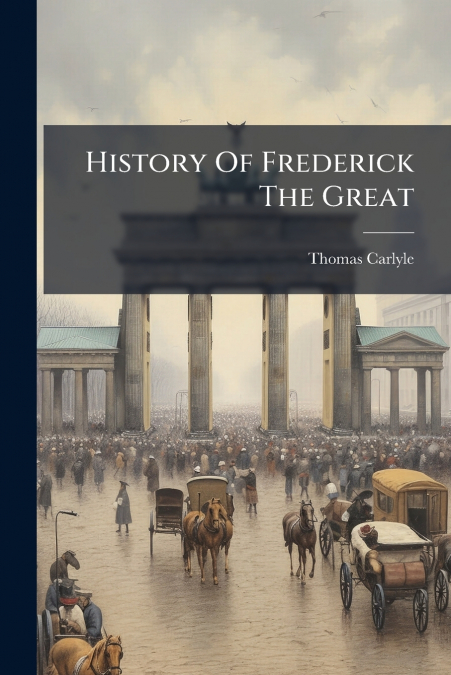
History Of Frederick The Great, by Thomas Carlyle, is a sweeping and detailed biography of one of the most important figures in Prussian and European history. Frederick II, known as Frederick the Great, ruled Prussia from 1740 to 1786, transforming it into a major military power. Carlyle’s work, while controversial for its hero-worship, offers a vivid portrait of the king, his military campaigns, and his impact on the political landscape of 18th-century Europe. This meticulously researched biography covers Frederick’s early life, his ascension to the throne, the Silesian Wars, the Seven Years’ War, and his later years focused on rebuilding and reforming Prussia. Carlyle’s narrative style, though dense, brings to life the complex personality of Frederick and the turbulent era in which he lived. Readers interested in military strategy, European history, and the lives of influential leaders will find this a compelling and insightful read.This work has been selected by scholars as being culturally important, and is part of the knowledge base of civilization as we know it. This work was reproduced from the original artifact, and remains as true to the original work as possible. Therefore, you will see the original copyright references, library stamps (as most of these works have been housed in our most important libraries around the world), and other notations in the work.This work is in the public domain in the United States of America, and possibly other nations. Within the United States, you may freely copy and distribute this work, as no entity (individual or corporate) has a copyright on the body of the work.As a reproduction of a historical artifact, this work may contain missing or blurred pages, poor pictures, errant marks, etc. Scholars believe, and we concur, that this work is important enough to be preserved, reproduced, and made generally available to the public. We appreciate your support of the preservation process, and thank you for being an important part of keeping this knowledge alive and relevant.