

 Librería Samer Atenea
 Kálamo Books
 Librería Elías (Asturias)
 Librería Kolima (Madrid)
 Librería Proteo (Málaga)
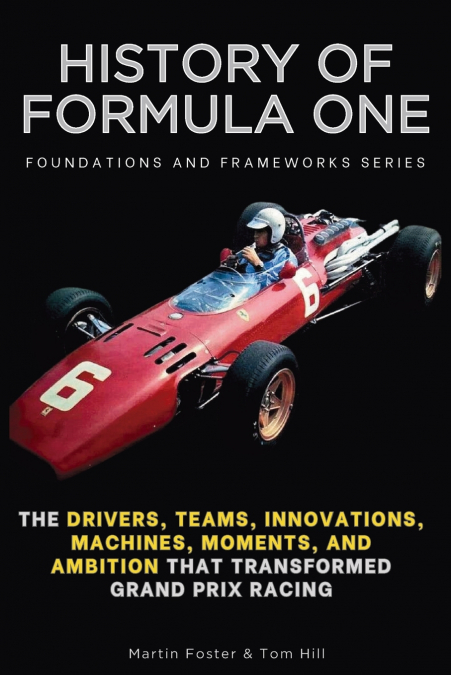
Formula One history, told in order and in plain language. This book follows Grand Prix racing through the 1894 Paris to Rouen trial, the Silver Arrows, the turbo era, and modern power unit rules, so you understand why the sport looks the way it does today. Eleven chapters move forward through time, and each one builds on the last. Once you reach the ground effect cars of the late 1970s, you already know the 1968 wing experiments that made them possible. When Mercedes wins eight constructors’ titles in a row, you recognize the pattern from the Ferrari and Red Bull runs that came before. Every technical idea, whether a stressed-skin monocoque or an MGU-H, gets explained without engineering jargon. The eras covered: - The 1903 Paris to Madrid race, stopped at Bordeaux after a string of deaths that ended city-to-city racing on public roads - Mercedes-Benz and Auto Union’s Silver Arrows, and Tazio Nuvolari’s 1935 upset at the Nürburgring in an outdated Alfa Romeo - Silverstone, 13 May 1950, and the first world title - Juan Manuel Fangio’s five championships with four manufacturers - Cooper, Colin Chapman’s Lotus 25, and the Cosworth DFV that debuted at Zandvoort in 1967 and powered the British constructors - Wings, venturi tunnels, the Brabham BT46B fan car, and turbo engines that passed 1,300 horsepower in qualifying - Imola, 1 May 1994, the deaths of Roland Ratzenberger and Ayrton Senna, and the decades of work by Sid Watkins that led to crash testing, the HANS device, and the halo - Schumacher’s five straight titles, Adrian Newey’s blown diffusers, and the Mercedes hybrid years - Bernie Ecclestone’s television deals, the Concorde Agreement, the tobacco ban, and Liberty Media’s 2017 purchase - The 2026-30 regulations, fully sustainable fuel, and new entries from Audi and Cadillac Built for study as well as reading: - A year-by-year historical timeline - Comparison tables inside the chapters - A question for thought at the end of each chapter, with example responses - A glossary of terms such as downforce, boost, and survival cell - Works cited and a recommended reading list for going further This book suits fans who: - Started watching through Drive to Survive and want the backstory - Longtime followers who never got the early decades straight - Students or teachers who need a structured history of motorsport (with a strong F1 focus). You don’t need an engineering background to follow any of it. You get more than a century of racing in one volume, with drivers, engineers, and rule changes placed in the order they happened. Certain patterns keep coming back. A small team finds an idea the big teams missed, rivals copy it within a season or two, and the rule makers answer with a new limit. Once you see that cycle, today’s arguments over rules and money stop looking random.





