Johann David Köhler / Elias Gottlieb Dieterich
 Librería Samer Atenea
 Kálamo Books
 Librería Elías (Asturias)
 Librería Kolima (Madrid)
 Librería Proteo (Málaga)
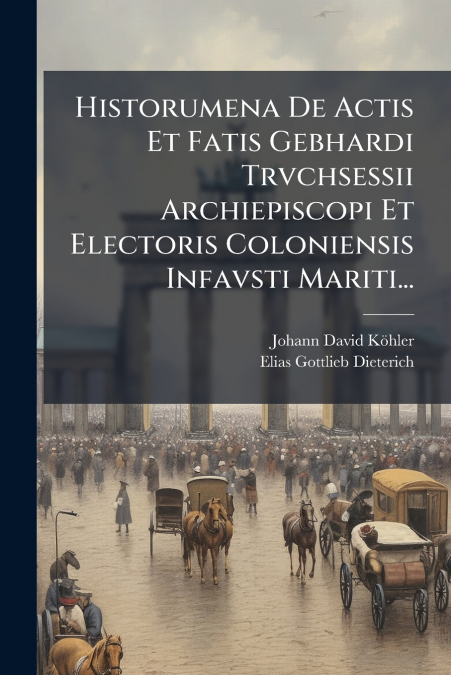
Historumena De Actis Et Fatis Gebhardi Trvchsessii Archiepiscopi Et Electoris Coloniensis Infavsti Mariti..., by Johann David Köhler and Elias Gottlieb Dieterich, delves into the tumultuous life and times of Gebhard Truchsess von Waldburg, Archbishop and Elector of Cologne. This historical account, written in Latin, explores the controversial marriage of Gebhard and its profound impact on the religious and political landscape of the Holy Roman Empire during the late 16th century. The book meticulously chronicles the events leading to the Cologne War, a conflict ignited by Gebhard’s conversion to Protestantism and his subsequent marriage, which defied canon law. It sheds light on the intricate power struggles between Catholic and Protestant factions, offering insights into the broader context of the Counter-Reformation. This historical work provides valuable perspectives on a pivotal moment in German history, revealing the personal drama and political machinations that shaped the era.This work has been selected by scholars as being culturally important, and is part of the knowledge base of civilization as we know it. This work was reproduced from the original artifact, and remains as true to the original work as possible. Therefore, you will see the original copyright references, library stamps (as most of these works have been housed in our most important libraries around the world), and other notations in the work.This work is in the public domain in the United States of America, and possibly other nations. Within the United States, you may freely copy and distribute this work, as no entity (individual or corporate) has a copyright on the body of the work.As a reproduction of a historical artifact, this work may contain missing or blurred pages, poor pictures, errant marks, etc. Scholars believe, and we concur, that this work is important enough to be preserved, reproduced, and made generally available to the public. We appreciate your support of the preservation process, and thank you for being an important part of keeping this knowledge alive and relevant.