Inicio > Derecho > Derecho internacional > Histories Written by International Criminal Courts and Tribunals
Histories Written by International Criminal Courts and Tribunals

Histories Written by International Criminal Courts and Tribunals

Aldo Zammit Borda

133,95 €
IVA incluido
Disponible
Editorial:
Springer Nature B.V.
Año de edición:
2021
Materia
Derecho internacional
ISBN:
9789462654297
133,95 €
IVA incluido
Disponible

Selecciona una librería:

  • Librería Samer Atenea
  • Librería Aciertas (Toledo)
  • Kálamo Books
  • Librería Perelló (Valencia)
  • Librería Elías (Asturias)
  • Donde los libros
  • Librería Kolima (Madrid)
  • Librería Proteo (Málaga)

This book argues for a more moderate approach to history-writing in international criminal adjudication by articulating the elements of a 'responsible history' normative framework. The question of whether international criminal courts and tribunals (ICTs) ought to write historical narratives has gained renewed relevance in the context of the recent turn to history in international criminal law, the growing attention to the historical legacies of the ad hoc Tribunals and the minimal attention paid to historical context in the first judgment of the International Criminal Court.The starting point for this discussion is that, in cases of mass atrocities, prosecutors and judges are inevitably understood to be engaged in writing history and influencing collective memory, whether or not they so intend. Therefore, while writing history is an inescapable feature of ICTs, there is still today a significant lack of consensus over the proper place of this function. Since Hannah Arendt articulated her doctrine of strict legality, in response to the prosecutor’s expansive didactic approach in Eichmann, the legal debate on the subject has been largely polarised between restrictive and expansive approaches to history-writing in mass atrocity trials. What has been noticeably missing from this debate is the middle ground. The contribution this book seeks to make is precisely to articulate a framework that occupies that ground. The book asks: what are the lenses through which judges of ICTs interpret historical events, what kind of histories do ICTs write? and what kinds of histories should ICTs produce? Its arguments for a more moderate approach to history-writing are based on three distinct, but interrelated grounds: (1) Truth and Justice; (2) Right to Truth; and (3) Legal Epistemology.Different target audiences may benefit from this book. Court officials and legal practitioners may find the normative framework developed herein useful in addressing the tensions between the competing objectives of ICTs and, in particular, in assessing the value of the history-writing function. Lawyers, historians and other academics may also find the analysis of the strengths, constraints and blind spots of the historical narratives written by ICTs interesting. This issue is particularly timely in view of current debates on the legacies of ICTs.Aldo Zammit Borda is Director of the Centre for Access to Justice and Inclusion at Anglia Ruskin University, Cambridge, UK.
Artículos relacionados

  • Comparative regulation, economic analysis, and applications of private equity in the united states and european union
    Irini Liakopoulou
    The present work examines the economics and legal doctrine of private equity. After a consideration of private equity’s origins, the book will explore the evolution of private equity in the United States and Europe. The reference economic model then will be reconstructed, with particular attention to financial flows to and from private equity firms and funds. This reconstructio...
  • Complicity in International Law
    Dimitris Liakopoulous
    Complicity in International Law aims to analyze questions arising from a state’s complicity in conflict with another state or an international organization. On the basis of international legal provisions, a state that assists the illicit fact of another state or an international organization in turn commits an offense if it is aware of the main fact and is bound by the same obl...
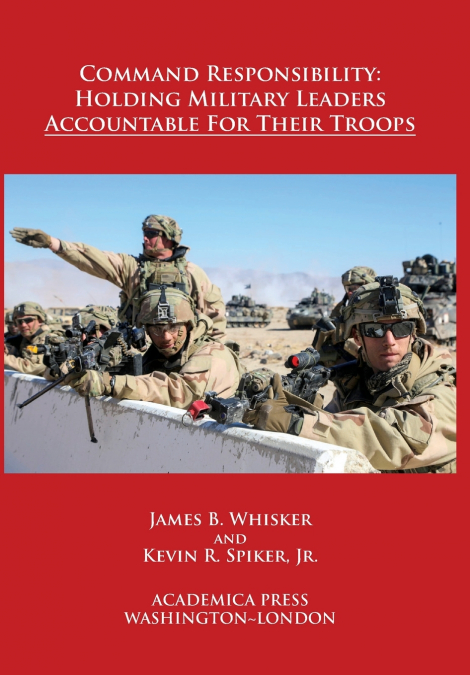
  • Command responsibility
    James B Whisker / Kevin R Spiker
    Command responsibility, or executive accountability, assumes that leaders are responsible for the actions of their subordinates. If subordinates misbehave, violate basic moral laws, transgress international law, or thwart international standards of behavior, their leader may be called before to justice. Standards that set the boundaries of human action have been evolving for ma...
  • International Organizations and Reparations
    Dimitris Liakopoulos
    In the first part of this book, noted legal scholar Dimtris Liakopoulos deals with reconstructing the legal regulatory framework governing human rights violations in the activities of organizations. After identifying rules that are generally applicable to organizations’ offenses and govern the profile of reparations, this study assesses primary rules that guarantee the right to...
  • International Organizations and Legal Sanctions Against Governments
    Dimitris Liakopoulos
    This book examines the relationship between governments and international organizations under international law. After surveying the policing powers of international organizations under international law, it illustrates some normative aspects of law that distinguish regulation from enforcement via study of recent legal cases before international judicial bodies. According to Di...
  • The EU Foreign Subsidies Regulation
    Andreas Reindl / Isabelle Van Damme
    'The EU Foreign Subsidies Regulation' is a pioneering manual authored by legal experts Andreas Reindl and Isabelle Van Damme. This essential guide, the first of its kind, is tailored for legal practitioners, offering a thorough exploration of the tools and mechanisms embedded within this novel European regulatory framework. The authors meticulously dissect the EU Foreign Subsid...

Otros libros del autor

  • Histories Written by International Criminal Courts and Tribunals
    Aldo Zammit Borda
    This book argues for a more moderate approach to history-writing in international criminal adjudication by articulating the elements of a 'responsible history' normative framework. The question of whether international criminal courts and tribunals (ICTs) ought to write historical narratives has gained renewed relevance in the context of the recent turn to history in internatio...
  • Legislative Drafting
    Aldo Zammit Borda
    This book provides, for the first time, detailed commentary on legislative drafting with a specific focus on the Commonwealth. It constitutes a key reference for legislative drafters, parliamentary counsel and professionals involved in this area in the Commonwealth and beyond.This book was published as a special issue in Commonwealth Law Bulletin. ...
    Disponible

    88,55 €

  • International Humanitarian Law and the International Red Cross and Red Crescent Movement
    Aldo Zammit Borda
    This book provides, for the first time, detailed commentary on legislative drafting with a specific focus on the Commonwealth.This book was published as a special issue in Commonwealth Law Bulletin. ...
    Disponible

    51,72 €

  • Legislative Drafting
    Aldo Zammit Borda
    This book provides, for the first time, detailed commentary on legislative drafting with a specific focus on the Commonwealth. It constitutes a key reference for legislative drafters, parliamentary counsel and professionals involved in this area in the Commonwealth and beyond.This book was published as a special issue in Commonwealth Law Bulletin. ...
  • International Humanitarian Law and the International Red Cross and Red Crescent Movement
    Aldo Zammit Borda
    This book provides, for the first time, detailed commentary on legislative drafting with a specific focus on the Commonwealth.This book was published as a special issue in Commonwealth Law Bulletin. ...