Georg-Friedrich Creuzer / Lampsacenus Charon / Milesius Hecataeus
 Librería Samer Atenea
 Kálamo Books
 Librería Elías (Asturias)
 Librería Kolima (Madrid)
 Librería Proteo (Málaga)
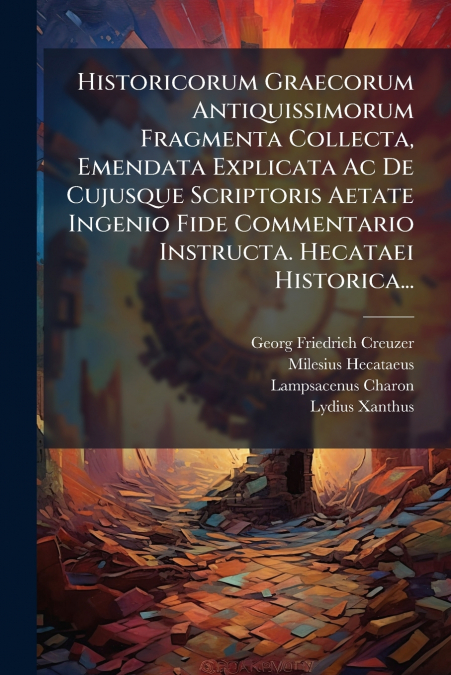
Historicorum Graecorum Antiquissimorum Fragmenta is a comprehensive collection of fragments from the earliest Greek historians, meticulously assembled and annotated. This work, compiled by Georg-Friedrich Creuzer, brings together the surviving writings of Hecataeus of Miletus, Charon of Lampsacus, Xanthus of Lydia, and others, offering invaluable insights into the formative stages of Greek historiography. Each fragment is carefully emended, explained, and contextualized with detailed commentary on the author’s life, character, and reliability. Creuzer’s compilation serves as an essential resource for scholars and students of ancient history, providing access to primary source material that sheds light on the cultural, political, and intellectual landscape of early Greece. This collection not only preserves these vital historical fragments but also facilitates a deeper understanding of the development of historical thought and writing in the ancient world.This work has been selected by scholars as being culturally important, and is part of the knowledge base of civilization as we know it. This work was reproduced from the original artifact, and remains as true to the original work as possible. Therefore, you will see the original copyright references, library stamps (as most of these works have been housed in our most important libraries around the world), and other notations in the work.This work is in the public domain in the United States of America, and possibly other nations. Within the United States, you may freely copy and distribute this work, as no entity (individual or corporate) has a copyright on the body of the work.As a reproduction of a historical artifact, this work may contain missing or blurred pages, poor pictures, errant marks, etc. Scholars believe, and we concur, that this work is important enough to be preserved, reproduced, and made generally available to the public. We appreciate your support of the preservation process, and thank you for being an important part of keeping this knowledge alive and relevant.