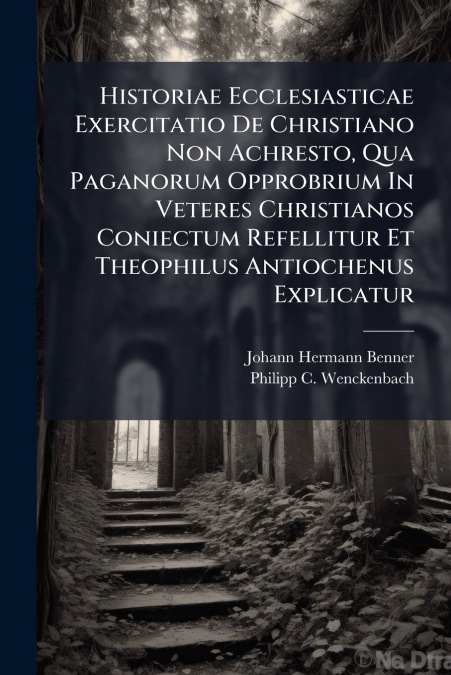
Johann Hermann Benner / Philipp C. Wenckenbach
 Librería Samer Atenea
 Kálamo Books
 Librería Elías (Asturias)
 Librería Kolima (Madrid)
 Librería Proteo (Málaga)
Historiae Ecclesiasticae Exercitatio De Christiano Non Achresto is a scholarly work that refutes pagan accusations against early Christians. Authored by Johann Hermann Benner and Philipp C. Wenckenbach, this book meticulously examines the historical context of the accusations and provides a detailed explanation of the writings of Theophilus of Antioch. The work delves into the complexities of early Christian apologetics, offering insights into how early believers defended their faith against external criticisms and misunderstandings. By addressing the specific charge of Christians being called ’Achrestos’ (meaning ’useless’ or ’bad’), the authors illuminate the challenges faced by the nascent Christian community within the broader Roman society. This historical study is valuable for scholars and readers interested in understanding the socio-religious dynamics of the early Church and the intellectual defenses crafted by early Christian theologians.This work has been selected by scholars as being culturally important, and is part of the knowledge base of civilization as we know it. This work was reproduced from the original artifact, and remains as true to the original work as possible. Therefore, you will see the original copyright references, library stamps (as most of these works have been housed in our most important libraries around the world), and other notations in the work.This work is in the public domain in the United States of America, and possibly other nations. Within the United States, you may freely copy and distribute this work, as no entity (individual or corporate) has a copyright on the body of the work.As a reproduction of a historical artifact, this work may contain missing or blurred pages, poor pictures, errant marks, etc. Scholars believe, and we concur, that this work is important enough to be preserved, reproduced, and made generally available to the public. We appreciate your support of the preservation process, and thank you for being an important part of keeping this knowledge alive and relevant.