

 Librería Samer Atenea
 Kálamo Books
 Librería Elías (Asturias)
 Librería Kolima (Madrid)
 Librería Proteo (Málaga)
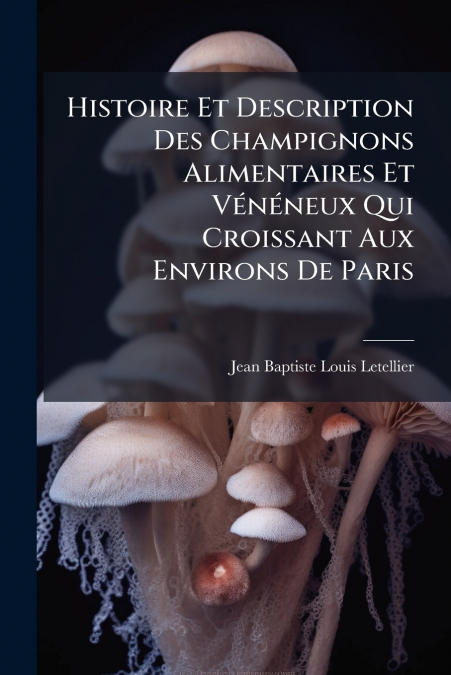
Histoire Et Description Des Champignons Alimentaires Et Vénéneux Qui Croissant Aux Environs De Paris by Jean Baptiste Louis Letellier offers a detailed exploration of mushrooms found in the Paris region. This book, 'preceded by the principles of botany indispensable to their study, and followed by plates representing more than one hundred species, lithographed, and colored,' serves as both a botanical guide and a practical manual. It delves into the characteristics of edible and poisonous mushrooms, providing essential knowledge for identifying and understanding these natural wonders.Letellier’s work combines scientific rigor with accessibility, making it valuable for both amateur enthusiasts and seasoned botanists. The descriptions are complemented by detailed illustrations, enhancing the reader’s ability to distinguish between different species. This historical text provides a fascinating glimpse into the botanical studies of the time and remains a significant contribution to the field of mycology.This work has been selected by scholars as being culturally important, and is part of the knowledge base of civilization as we know it. This work was reproduced from the original artifact, and remains as true to the original work as possible. Therefore, you will see the original copyright references, library stamps (as most of these works have been housed in our most important libraries around the world), and other notations in the work.This work is in the public domain in the United States of America, and possibly other nations. Within the United States, you may freely copy and distribute this work, as no entity (individual or corporate) has a copyright on the body of the work.As a reproduction of a historical artifact, this work may contain missing or blurred pages, poor pictures, errant marks, etc. Scholars believe, and we concur, that this work is important enough to be preserved, reproduced, and made generally available to the public. We appreciate your support of the preservation process, and thank you for being an important part of keeping this knowledge alive and relevant.






