 Librería Samer Atenea
 Kálamo Books
 Librería Elías (Asturias)
 Librería Kolima (Madrid)
 Librería Proteo (Málaga)
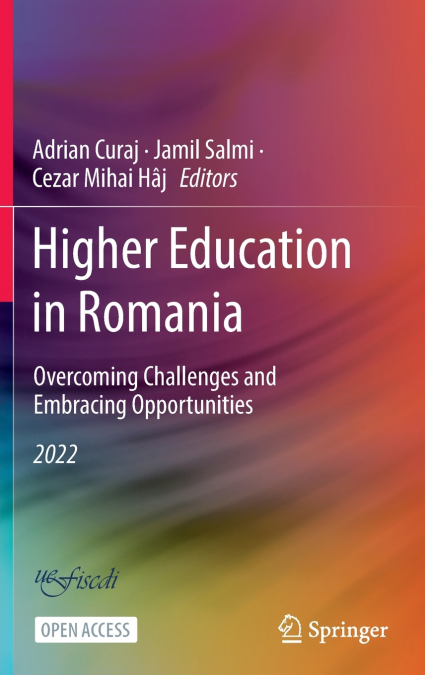
This open access book includes a series of relevant policy research articles, elaborared in the framework of the 'Quality in higher education: internationalisation and databases to enhance the Romanian education system' project, implemented by the Executive Agency for Higher Education, Research, Development and Innovation Funding (UEFISCDI), together with the Ministry of Education. The project aims to develop and implement systemic measures at tertiary education level, leading to an increased quality of the overall higher education system and universities better prepared for labour market requirements and international standards. The book focuses on areas of interest for Romanian higher education, such as systemic measures to improve access, participation and completion for (vulnerable) students, better promotion of the Romanian higher education to attract students, as well as instruments for a more efficient use of data at higher education level. Each article includes evidence-based policy proposals that could support new strategic initiatives in higher education, including new legislation. Additionally, the collection of articles tells a comprehensive story about the audacity of a higher education system which went through significant challenges to align itself with both European and international trends, as well as respond to national imperatives.Over the last three decades, since the fall of the Iron Curtain, Romanian higher education has undergone significant transformations, aiming to align itself to the latest developments and trends at European and international level. The National Law on Education no. 1/2011 has set the stage for a full implementation of the Bologna Process action lines, taking into account that Romania was already a part of the largest European intergovernmental process - currently the European Higher Education Area (EHEA) - as a founding member.However, since the adoption of this normative framework, the law suffered numerous amendments, making it challenging to observe and achieve coherence in its implementation. Furthermore, Romania is also currently redesigning the strategy for the alocation of European structural funds 2021-2027, based on two strategic documents - the new Education and Employment Operational Programme and the National Recovery and Resilience Plan which highlight the reform and investment priorities at a national level.At the same time, 2021 is a good time to analyze the level of implementation for the objectives and measures included in the National Strategy for Tertiary Education 2015-2020, the Europe 2020 Strategy, and the Bologna Process action lines in the 2010 - 2020 timeframe. Therefore, the present moment may be an important time to assess the impact of strategic documents and actions in the last decade and, possibly, to draft a new National Education Law, better adapted to current realities, starting from the recent initiative by the President of Romania - the Educated Romania strategic vision which was also politically assumed by the Romanian Government.