

 Librería Samer Atenea
 Kálamo Books
 Librería Elías (Asturias)
 Librería Kolima (Madrid)
 Librería Proteo (Málaga)
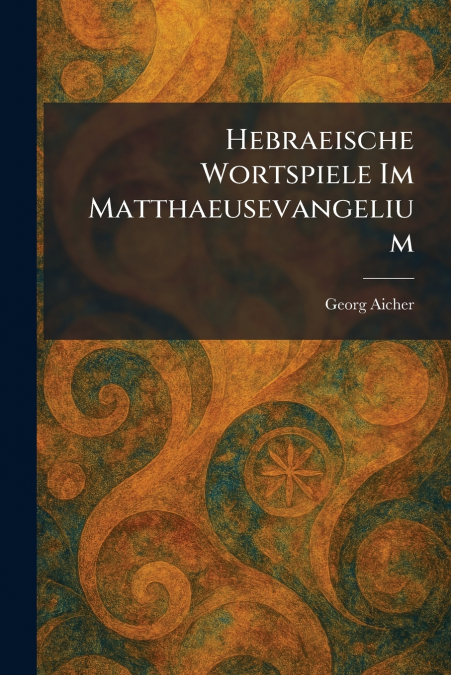
In 'Hebraeische Wortspiele Im Matthaeusevangelium' untersucht Georg Aicher die sprachliche Tiefe und die semitischen Wurzeln des ersten Evangeliums. Das Werk widmet sich der detaillierten Analyse von Wortspielen, Alliterationen und rhetorischen Figuren, die auf einen ursprünglichen hebräischen oder aramäischen Hintergrund des Textes hindeuten. Aicher zeigt auf, wie diese sprachlichen Nuancen nicht nur die literarische Qualität des Evangeliums steigern, sondern auch entscheidende Hinweise auf die theologische Intention und die Adressatenschaft des Autors liefern.Die Untersuchung führt den Leser durch zahlreiche Passagen des Matthäusevangeliums und erläutert, wie durch die Rückübersetzung ins Hebräische verborgene Sinnzusammenhänge und kunstvolle Wortverknüpfungen sichtbar werden. Diese philologische Arbeit bietet wertvolle Einblicke für Theologen, Sprachwissenschaftler und alle, die an der Entstehungsgeschichte des Neuen Testaments interessiert sind. 'Hebraeische Wortspiele Im Matthaeusevangelium' bleibt ein bedeutender Beitrag zur Forschung über die semitischen Einflüsse in der christlichen Heiligen Schrift und beleuchtet die Verbindung zwischen jüdischer Gelehrsamkeit und frühchristlicher Verkündigung.This work has been selected by scholars as being culturally important, and is part of the knowledge base of civilization as we know it. This work was reproduced from the original artifact, and remains as true to the original work as possible. Therefore, you may see the original copyright references, library stamps (as most of these works have been housed in our most important libraries around the world), and other notations in the work.This work is in the public domain in the United States of America, and possibly other nations. Within the United States, you may freely copy and distribute this work, as no entity (individual or corporate) has a copyright on the body of the work.As a reproduction of a historical artifact, this work may contain missing or blurred pages, poor pictures, errant marks, etc. Scholars believe, and we concur, that this work is important enough to be preserved, reproduced, and made generally available to the public. We appreciate your support of the preservation process, and thank you for being an important part of keeping this knowledge alive and relevant.





