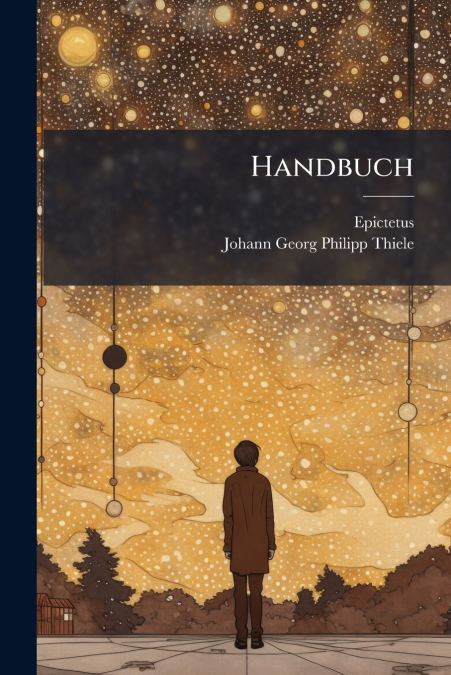
Epictetus / Johann Georg Philipp Thiele
 Librería Samer Atenea
 Kálamo Books
 Librería Elías (Asturias)
 Librería Kolima (Madrid)
 Librería Proteo (Málaga)
This handbook, originally written by Epictetus and translated by Johann Georg Philipp Thiele, offers timeless wisdom on how to live a virtuous and fulfilling life. Rooted in Stoic philosophy, the work emphasizes the importance of focusing on what we can control-our thoughts and actions-and accepting what we cannot. Readers will find practical guidance on cultivating inner resilience, managing emotions, and finding contentment amidst life’s inevitable challenges.Through clear and accessible prose, the handbook provides profound insights into ethics, self-discipline, and the pursuit of inner peace. Its enduring appeal lies in its ability to empower individuals to take responsibility for their own well-being and to live in accordance with reason and virtue. A valuable resource for anyone seeking personal growth and a deeper understanding of themselves and the world around them.This work has been selected by scholars as being culturally important, and is part of the knowledge base of civilization as we know it. This work was reproduced from the original artifact, and remains as true to the original work as possible. Therefore, you will see the original copyright references, library stamps (as most of these works have been housed in our most important libraries around the world), and other notations in the work.This work is in the public domain in the United States of America, and possibly other nations. Within the United States, you may freely copy and distribute this work, as no entity (individual or corporate) has a copyright on the body of the work.As a reproduction of a historical artifact, this work may contain missing or blurred pages, poor pictures, errant marks, etc. Scholars believe, and we concur, that this work is important enough to be preserved, reproduced, and made generally available to the public. We appreciate your support of the preservation process, and thank you for being an important part of keeping this knowledge alive and relevant.