 Librería Samer Atenea
 Kálamo Books
 Librería Elías (Asturias)
 Librería Kolima (Madrid)
 Librería Proteo (Málaga)
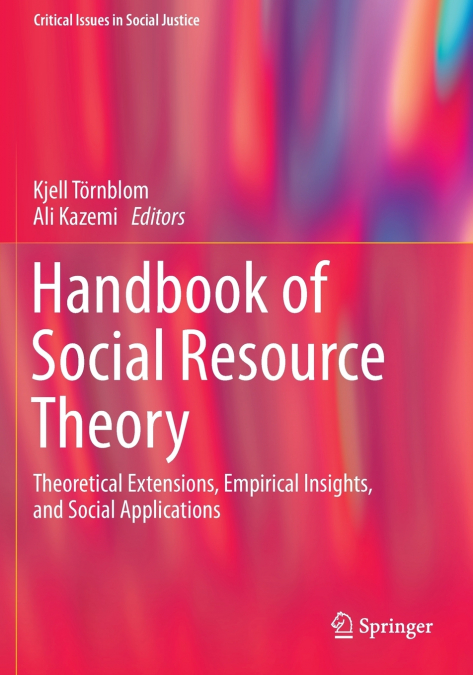
Our lives as human beings are characterized by production and use of social resources, material (e.g., money and physical possessions) as well as immaterial (such as love, knowledge, and power). Distribution and exchange of these resources are central to individuals’ physical and mental health and quality of life. Over the past four decades, Social Resource Theory (SRT) has evolved to build vital links between social psychology and public policy, providing a valuable lens for understanding and addressing social class, inequality, and injustice. The recent conceptual and theoretical developments and future prospects of this robust field are on full display in this Handbook of Social Resource Theory. An international, interdisciplinary panel of experts expands on the pioneering work of the late Dr. Uriel Foa and his wife Edna Foa, starting with the basic structure of SRT. The Handbook includes integrations of SRT with other social scientific frameworks, analyses of organizational and cultural issues, reports of empirical research using various methods, as well as applications to different areas including:Social justiceQuality of lifeInterpersonal relationshipsSocial dilemmasStress managementWork satisfactionCognitive developmentConsumer behaviorCross-cultural behaviorCovering human social transactions from the interpersonal to the intercultural levels, the Handbook of Social Resource Theory extends this relevant line of study to enhance the work of social psychologists, sociologists, anthropologists, political scientists, and public policy makers. 'The Handbook presents the basic tenets of the social resource theory originated from the late Uriel Foa and provides an authoritative agenda for the future developments of this theory. Kjell Törnblom and Ali Kazemi have made an excellent job in gathering a global group of contributing scholars representing an outstanding mix of respected and long-standing researchers in social psychology, sociology, psychology, management, economics and marketing, political science, history, and applied ethics/philosophy. This Handbook is an ideal resource for researchers, instructors, and graduate students in all these fields with an interest in social resource theory.'Edna B. FoaProfessor of Clinical Psychology, University of Pennsylvania'Uriel Foa (1916-1990) developed social resource theory in the 1960s. In the next half century this theory has generated an enormous amount of new data and theory in social, cross-cultural, and educational psychology, as well as in related disciplines. It has inspired work on interpersonal relationships, attributions, the understanding of status, morality, distributive justice, procedural justice, social dilemmas, interpersonal evaluation, biosocial theory, and action construal. Applications in both organizational and educational settings and in marketing studies indicate the theory’s relevance for the 'real world.' This volume edited by Kjell Törnblom and Ali Kazemi is the wonderful Festschrift that Foa did not have, because he died when he was too young by contemporary life expectancy standards. It includes chapters by many of the stars of the fields that social resource theory has influenced.'Harry C. TriandisProfessor Emeritus, University of Illinois 'Forty years ago Edna and Uriel Foa began to spell out the unwritten social rules by which we trade - on a daily basis - friendship, information, respect, gifts, favors and other rewards and punishments. Sociologists, psychologists, economists, and others owe the editors a tremendous debt of gratitude for reminding us of the eloquence and indispensability of the original work on social resource theory and for bringing to