 Librería Samer Atenea
 Kálamo Books
 Librería Elías (Asturias)
 Librería Kolima (Madrid)
 Librería Proteo (Málaga)
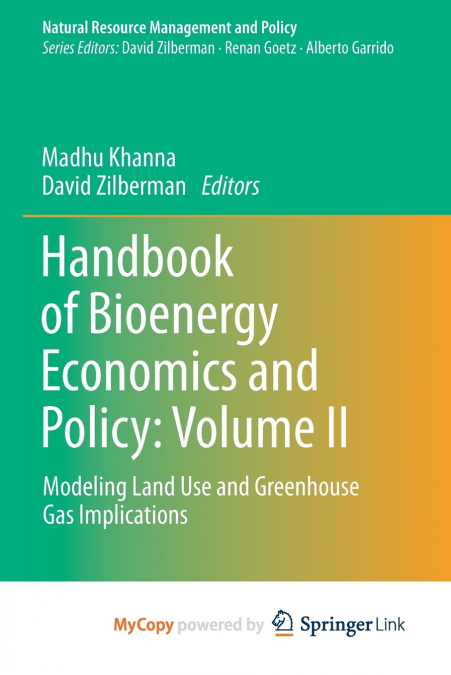
In its second volume, this book aims to link the academic research with development in the real world and provide a historical and institutional background that can enrich more formal research. The first section will include an assessment of the evolution and the state of the nascent second-generation biofuel as well as a perspective on the evolution of corn ethanol and sugarcane ethanol in Brazil. It will also include a historical and institutional background on the biofuel industry in Brazil that has global lessons, and later, provide a technical overview of major analytical tools used to assess the economic, land use and greenhouse gas implications of biofuel policies at a regional and global level. Additionally, the book analyzes the various drivers for land use change both at a micro-economic level and at a macro-economic level. It presents studies that apply regional and global economic models to examine the effects of biofuel policies in the US, EU and Brazil on regional and global land use, on food and fuel prices and greenhouse gas emissions. These papers illustrate the use of partial and general equilibrium modeling approaches to simulate the effects of various biofuel policies, and includes studies showing the effects of risk aversion, time preferences and liquidity constraints on farmers decision to grow energy crops for biofuel production. By presenting the tools of lifecycle analysis for assessing the direct greenhouse gas intensity of biofuels, this handbook investigates the types of indirect or market mediated effects that can offset or strengthen these direct effects. It will include tools to assess the direct and indirect effects of biofuel production on greenhouse gas emissions in the US and Brazil, and ultimately provide a comprehensive background to understand the state of biofuel in the present and how to analyze their implication.