

Jean-Girard Lacuée (comte de Cessac)
 Librería Samer Atenea
 Kálamo Books
 Librería Elías (Asturias)
 Librería Kolima (Madrid)
 Librería Proteo (Málaga)
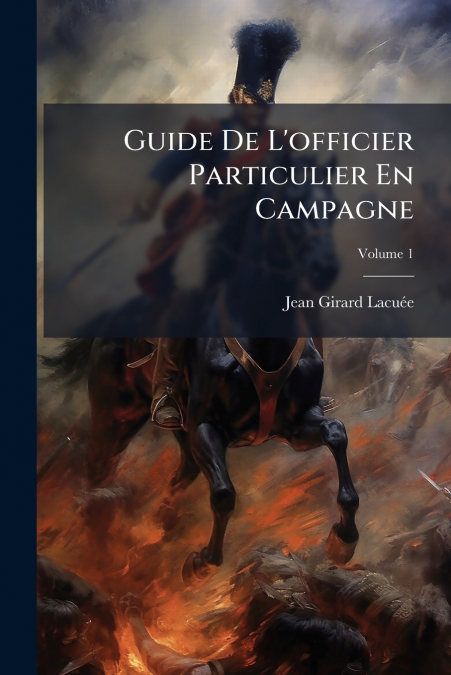
Guide De L’officier Particulier En Campagne, Ou Connoissances Militaires Nécessaires Pendant La Guerre Aux Officiers Particuliers, Volume 1, is a comprehensive military guide for officers during wartime. Penned by Jean-Girard Lacuée (comte de Cessac), this book provides essential knowledge and strategic insights necessary for officers in the field. Detailing various aspects of military operations, tactics, and leadership, it serves as a valuable resource for understanding the nuances of warfare during the Napoleonic era. This guide offers a unique glimpse into the training and expectations placed upon officers of the time, making it an invaluable historical document for military historians and enthusiasts alike. The book’s enduring relevance lies in its detailed examination of military strategy and the practical knowledge it imparts to officers navigating the complexities of war.This work has been selected by scholars as being culturally important, and is part of the knowledge base of civilization as we know it. This work was reproduced from the original artifact, and remains as true to the original work as possible. Therefore, you will see the original copyright references, library stamps (as most of these works have been housed in our most important libraries around the world), and other notations in the work.This work is in the public domain in the United States of America, and possibly other nations. Within the United States, you may freely copy and distribute this work, as no entity (individual or corporate) has a copyright on the body of the work.As a reproduction of a historical artifact, this work may contain missing or blurred pages, poor pictures, errant marks, etc. Scholars believe, and we concur, that this work is important enough to be preserved, reproduced, and made generally available to the public. We appreciate your support of the preservation process, and thank you for being an important part of keeping this knowledge alive and relevant.





