

 Librería Samer Atenea
 Kálamo Books
 Librería Elías (Asturias)
 Librería Kolima (Madrid)
 Librería Proteo (Málaga)
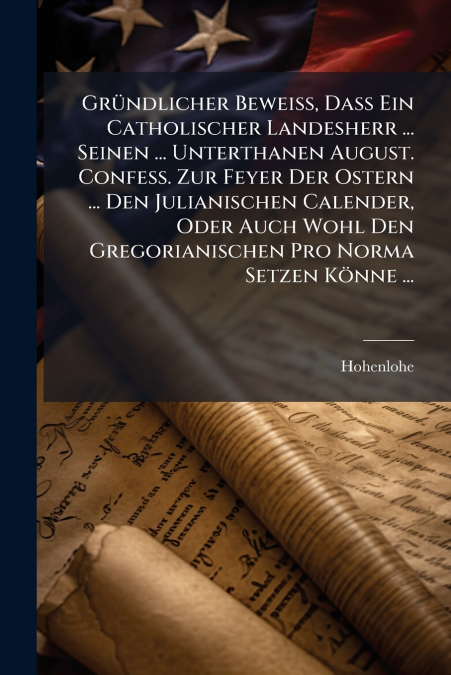
Gründlicher Beweis, Daß Ein Catholischer Landesherr ... Seinen ... Unterthanen August. Confess. Zur Feyer Der Ostern ... Den Julianischen Calender, Oder Auch Wohl Den Gregorianischen Pro Norma Setzen Könne ... is a historical legal treatise concerning the rights of Catholic rulers in relation to their Protestant subjects. Specifically, it addresses the controversial issue of calendar usage-the Julian versus the Gregorian calendar-in the context of observing Easter. Authored by Hohenlohe, this work delves into constitutional and religious law, arguing the extent to which a Catholic ruler could impose a particular calendar on adherents to the Augsburg Confession within their territory. This book provides insights into the complex religious and legal landscape of the time, reflecting the tensions and negotiations between different Christian denominations in early modern Europe.This work has been selected by scholars as being culturally important, and is part of the knowledge base of civilization as we know it. This work was reproduced from the original artifact, and remains as true to the original work as possible. Therefore, you will see the original copyright references, library stamps (as most of these works have been housed in our most important libraries around the world), and other notations in the work.This work is in the public domain in the United States of America, and possibly other nations. Within the United States, you may freely copy and distribute this work, as no entity (individual or corporate) has a copyright on the body of the work.As a reproduction of a historical artifact, this work may contain missing or blurred pages, poor pictures, errant marks, etc. Scholars believe, and we concur, that this work is important enough to be preserved, reproduced, and made generally available to the public. We appreciate your support of the preservation process, and thank you for being an important part of keeping this knowledge alive and relevant.





