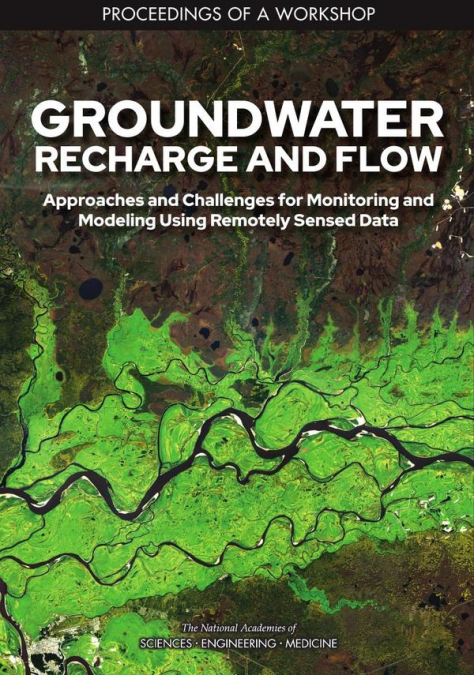

Groundwater Recharge and Flow

Groundwater Recharge and Flow

AA.VV

45,24 €
IVA incluido
Disponible
Editorial:
National Academies Press
Año de edición:
2019
Materia
Ciencias de la tierra/geociencias
ISBN:
9780309499644
45,24 €
IVA incluido
Disponible

Selecciona una librería:

  • Librería Samer Atenea
  • Librería Aciertas (Toledo)
  • Kálamo Books
  • Librería Perelló (Valencia)
  • Librería Elías (Asturias)
  • Donde los libros
  • Librería Kolima (Madrid)
  • Librería Proteo (Málaga)

Water of appropriate quantity and quality is essential for drinking, sanitation, and food, energy, and industrial production for any society and is derived for most needs from surface- or groundwater sources. Studies suggest that groundwater use in irrigation globally is increasing in total volume as well as a percentage of all water used for irrigation, with the demand for groundwater resources increasing as available primary surface water supplies are depleted. Particularly in arid regions, groundwater may be the most accessible water supply for any purpose, leaving groundwater withdrawals concentrated in areas that are already experiencing water stress. Even in the presence of direct ground observations and measurements of the water table, quantitative evaluation of groundwater storage, flow, or recharge at different scales requires remotely sensed data and observations applied to groundwater models. Resolving the interaction of groundwater storage, flow, and recharge at a scale at which basins are managed requires remotely sensed data and proxy data. In June 2019, the Water Science and Technology Board of the National Academies of Sciences, Engineering, and Medicine convened a workshop to identify scientific and technological research frontiers in monitoring and modeling groundwater recharge and flow in various regions of the world. The goals of the workshop were to assess regional freshwater budgets under major use scenarios, including agriculture, industry, and municipal; examine state of the art research frontiers in characterizing groundwater aquifers, including residence time, quantity, flow, depletion, and recharge, using remotely sensed observations and proxy data; discuss groundwater model uncertainties and methods for mitigating them using sparse ground observations or data and other approaches; and consider our ability to detect which water management strategies that affect groundwater flow and recharge are being used and any changes in their use over time. This publication summarizes workshop presentations and plenary discussions.

Artículos relacionados

  • Polarimetric SAR Techniques and Applications
    Carlos López-Martínez / Juan Manuel Lopez-Sanchez
    An increasing number of spaceborne Synthetic Aperture Radar (SAR) systems have been equipped with polarimetric capabilities: ALOS and ALOS-2, Radarsat-2, TerraSAR-X, Envisat-ASAR, Sentinel-1a/b, etc. Future mission will still present this type of diversity: RCM, SAOCOM, Cosmo-Skymed 2nd generation or PAZ. Polarimetry allows sensitivity to the structural and geometric properties...
    Disponible

    59,61 €

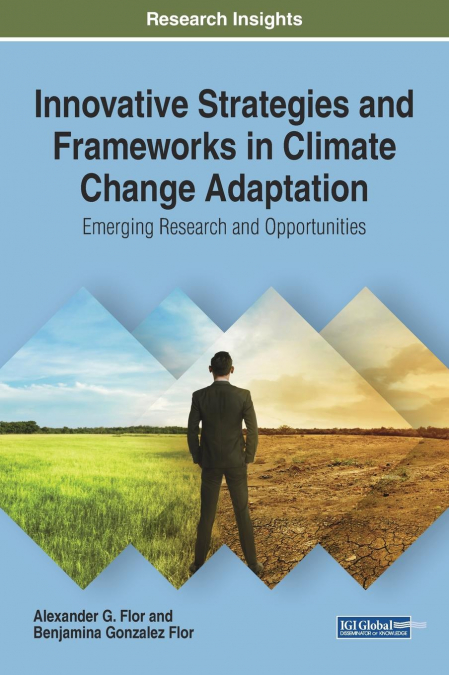
  • Innovative Strategies and Frameworks in Climate Change Adaptation
    Alexander G. Flor / Alexander GFlor / Benjamina Gonzalez Flor
    The changes the earth is currently undertaking has been at the forefront of scientific discourse in recent years. Humans as a species have needed to react to these changes and shift their behavior accordingly. Innovative Strategies and Frameworks in Climate Change Adaptation: Emerging Research and Opportunities is a critical scholarly resource that examines the relationship bet...
  • Air Quality Monitoring and Forecasting
    Air quality is personal. Its management is highly so. Asthmatic or air-pollutant-sensitive individuals depend on accurate air quality forecasts to help manage their daily activities.  However, the adverse effects of poor air quality on public health and visibility extend far beyond the daily time horizon. Pneumonic and cardiac vascular responses of individuals in all age groups...
    Disponible

    59,74 €

  • Application of Artificial Neural Networks in Geoinformatics
    Saro Lee
    Recently, a need has arisen for prediction techniques that can address a variety of problems by combining methods from the rapidly developing field of machine learning with geoinformation technologies such as GIS, remote sensing, and GPS. As a result, over the last few decades, one particular machine learning technology, known as artificial neural networks, has been successfull...
    Disponible

    59,81 €

  • Coastal Sea Levels, Impacts and Adaptation
    Extreme sea levels can lead to hazardous events, such as coastal flooding, erosion, or salt water intrusion, with-wide ranging environmental, societal, and economic consequences. In combination with climate-driven sea-level rise, and, potentially, additional changes in storminess, dynamic wave contributions, and tidal dynamics, the adverse consequences of extreme oceanographic ...
    Disponible

    75,97 €

  • Application of Plant Biotechnology in Forestry
    The aim of this reprint is to immerse the reader in the latest biotechnological approaches employed in forestry. From rejuvenation through clonal propagation to somatic embryogenesis, the cryopreservation of germplasm, and the use of molecular techniques and genetic engineering, we aim to unravel the potential and promise of these cutting-edge technologies. In this reprint, lea...